

The moment your power goes out, a clock starts on your refrigerator, and it’s shorter than most people assume. This guide covers exactly what that timeline looks like according to USDA, FDA, and CDC guidance, what’s actually happening inside the appliance while it sits without power, and the real backup options, from a cooler full of ice to a whole-home battery, for keeping food safe through a longer outage.
This connects directly to our wildfire and outage preparedness library: see What Is a Public Safety Power Shutoff?, How to Prepare for California PSPS Power Shutoffs, and Best Backup Power Options During Wildfires.
How Long Is Food Actually Safe in the Refrigerator During a Power Outage?
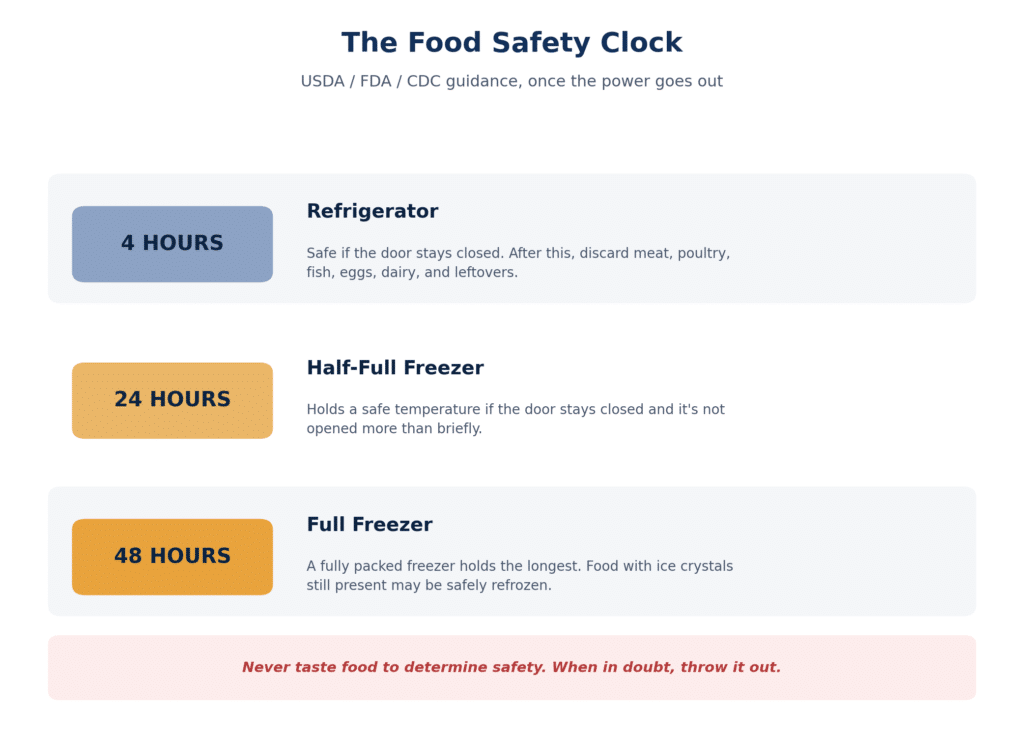
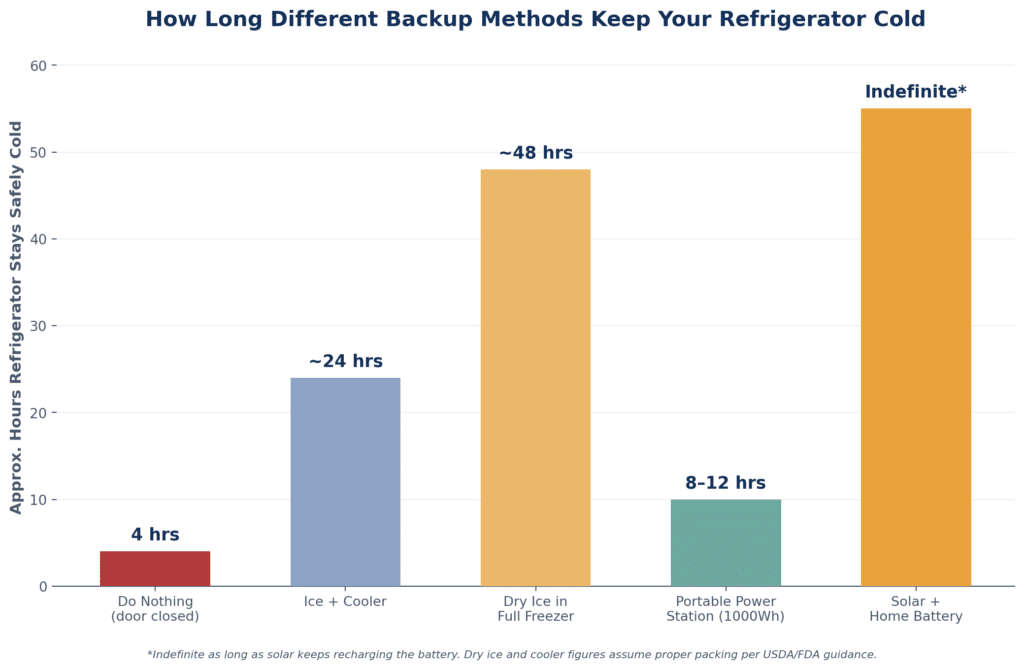
According to FoodSafety.gov, citing USDA guidance, your refrigerator keeps food safe for up to 4 hours during a power outage, as long as the door stays closed. After 4 hours, the USDA’s Food Safety and Inspection Service recommends discarding perishables: meat, poultry, fish, eggs, dairy, and leftovers. Your freezer buys more time: a full freezer holds a safe temperature for approximately 48 hours, while a half-full freezer holds for about 24 hours, per the same USDA guidance and confirmed by the CDC. Food that still contains ice crystals or reads 40°F or below may be safely refrozen, though quality may suffer. The rule everyone from USDA to CDC repeats: never taste food to determine whether it’s safe, and when in doubt, throw it out.
What’s Actually Happening Inside Your Refrigerator
Once power cuts out, the compressor stops cycling and the interior simply begins warming toward room temperature, at a rate that depends heavily on how full the unit is and how often the door opens. A full freezer holds cold longer than a half-full one for a simple reason: frozen food acts as thermal mass, each package helps keep its neighbors cold, which is why USDA specifically recommends grouping freezer packages together into an “igloo” if the freezer isn’t full, so they insulate each other rather than sitting exposed.
Every door opening lets warm air in and cold air out, which is why the single most effective thing you can do during an outage is also the simplest: leave the doors shut. If you’re not sure how long the power’s actually been out, or you want certainty instead of a guess, an appliance thermometer left inside the unit gives you a hard number: discard anything that’s been above 40°F for more than 2 hours.
Can a Home Battery Keep a Refrigerator Running Through a Multi-Day Outage?
Yes, and it’s one of the lightest loads a battery system carries. A typical refrigerator draws 150 to 400 watts when its compressor is actively running, but it cycles on and off rather than running continuously, so its average draw over a full day is usually closer to 100 to 150 watts. Run the math on a single 13.5 kWh home battery powering only the refrigerator: 13,500 watt-hours divided by roughly 120 watts average draw works out to more than 110 hours, well over four days, before accounting for anything else on the circuit.
According to the California Public Utilities Commission, a single home battery typically covers priority circuits like the refrigerator for 24 to 48 hours when it’s also running other essential loads, and if solar is recharging it during the day, that runtime extends indefinitely for as long as the outage lasts. We cover the full sizing math and worked examples across other appliances in How Long Can a Home Battery Power Your House?
Portable Refrigerator Backup vs. Whole-Home Backup
A portable power station, roughly 1,000 watt-hours or larger, can typically run a modern refrigerator for 8 to 12 hours on its own, useful for a shorter outage or as a backup to your backup. The gap between that and whole-home coverage is capacity and recharging: a portable unit is a fixed amount of stored energy that runs out and stays out unless you add a solar panel accessory, while a home battery wired into your panel switches on automatically and, paired with solar, recharges every day the outage continues. We rank the full set of backup power options, including generators and EV-based backup, in Best Backup Power Options During Wildfires.
Should I Prioritize the Refrigerator When Sizing a Battery System?
Yes, for two reasons that go beyond convenience. First, it’s cheap to protect: refrigeration is one of the lowest-wattage critical loads in a typical home, so it adds very little to a properly sized battery system. Second, the cost of not protecting it is real and immediate.
Replacing a typical refrigerator’s full contents runs around $200, and standard homeowners insurance food-spoilage coverage is usually capped at $500 to $1,000, according to American Family Insurance, meaning a bad outage can still cost you out of pocket even with coverage. If anyone in the household relies on refrigerated medication, the priority goes from “worth protecting” to essential, which is exactly why refrigeration and medical devices are usually grouped on the same critical-loads circuit in a well-designed system.
Building a Power Outage Kit That Actually Covers the Refrigerator
A general emergency kit and a refrigerator-specific plan overlap but aren’t identical. Beyond the standard water, non-perishable food, flashlights, and first aid supplies, a power outage kit built around protecting your fridge and freezer should include a working appliance thermometer, a cooler and enough ice or reusable gel packs to bridge a short outage, and, per FDA guidance, a plan for dry or block ice if an outage is expected to run long: 50 pounds of dry ice can keep a fully stocked 18-cubic-foot freezer cold for about two days. Freezing water in containers ahead of a known risk period, like an incoming storm or a PSPS watch, is a free way to add thermal mass before the power even goes out.
Can HomeLink Solar Size a System That Covers Refrigeration and Medical Equipment Together?
Yes. HomeLink Solar designs critical-loads battery systems around the specific circuits that matter most to your household, refrigeration, medical equipment, communication, and lighting, sized together rather than treated as separate afterthoughts. Owner Mandy oversees every install personally, with no subcontractors. See real completed installs on our our installs page, explore no-large-upfront-cost options through our Power Choice Program, or get a free personalized quote.
FAQs
How long is food safe in the refrigerator during a power outage?
Up to 4 hours if the door stays closed, per USDA and FDA guidance. A full freezer holds for about 48 hours, a half-full freezer for about 24 hours. Discard perishables like meat, poultry, fish, eggs, and dairy after the refrigerator window passes.
Can a home battery keep a refrigerator running through a multi-day outage?
Yes. A refrigerator’s average draw (100 to 150 watts accounting for its duty cycle) is a light load for a home battery, a single 13.5 kWh battery running only the fridge can last well over four days, and indefinitely if paired with solar recharging.
What’s the difference between a portable refrigerator backup and whole-home backup?
A portable power station (around 1,000 watt-hours) typically runs a refrigerator for 8 to 12 hours before it’s depleted, and won’t recharge itself without an added solar panel. A home battery wires into your panel, switches on automatically, and can recharge daily from solar for as long as the outage lasts.
Should I prioritize the refrigerator when sizing a battery system?
Yes. It’s one of the lowest-wattage critical loads in a home, so it’s inexpensive to protect, and the cost of not protecting it, spoiled food and potentially spoiled refrigerated medication, is immediate and real, often exceeding standard insurance food-spoilage limits.
Can HomeLink Solar size a system that covers refrigeration and medical equipment together?
Yes. HomeLink Solar designs critical-loads systems around your household’s specific priority circuits, refrigeration, medical equipment, communication, and lighting together, rather than a generic package, with owner Mandy personally overseeing every install.
Related Reading
See How Long Can a Home Battery Power Your House? for the full appliance-by-appliance runtime math, Best Backup Power Options During Wildfires for a ranked comparison of every backup option, What Is a Public Safety Power Shutoff? and How to Prepare for California PSPS Power Shutoffs for why these outages happen in the first place. For solar and battery basics, see our Learn hub, and for programs with no large upfront cost, our Power Choice Program.
Sources
- FoodSafety.gov — Food Safety During Power Outage
- USDA FSIS — Keep Your Food Safe During Emergencies
- FDA — Food and Water Safety During Power Outages and Floods
- CDC — Discarding Food After a Power Outage
- USDA — Winter Storm Food Safety Guidelines
- American Family Insurance — Reimbursement for Power Outage Food Loss
- California Public Utilities Commission — Public Safety Power Shutoff FAQs