If you’ve already read What Is a Public Safety Power Shutoff?, you know the safety case against generators during wildfire conditions. This guide picks up from there with a more direct question: given every option on the market, ranked, which one should you actually buy? We’ve included one option that guide didn’t cover, using an EV as backup power, since it’s genuinely changed the landscape in the last year.
How We Ranked These
Four criteria, in order: safety during the specific conditions that cause a PSPS or wildfire evacuation (dry vegetation, wind, the need to leave quickly), usable capacity for real household loads, whether it switches on automatically or needs manual setup, and installed cost. See our full guide on how to prepare for California PSPS power shutoffs for the trigger conditions this ranking is built around.
#1: Whole-Home or Critical-Loads Solar Battery
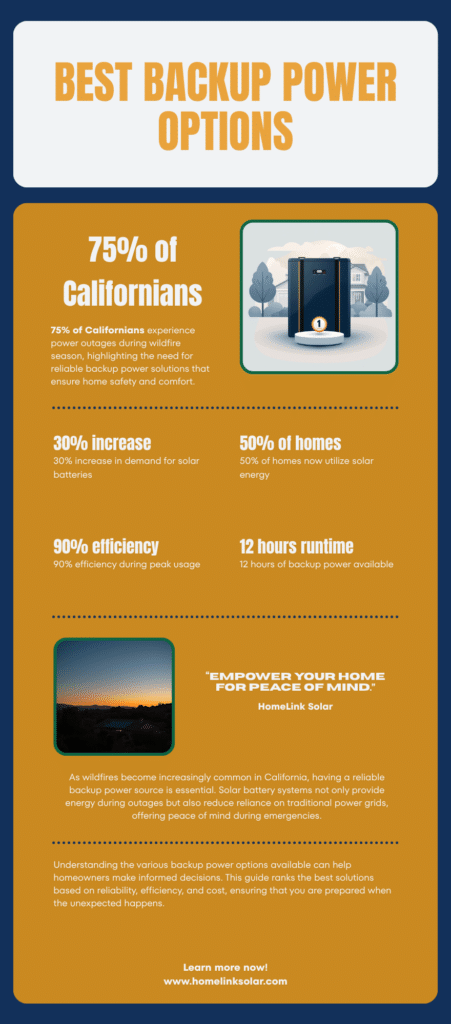
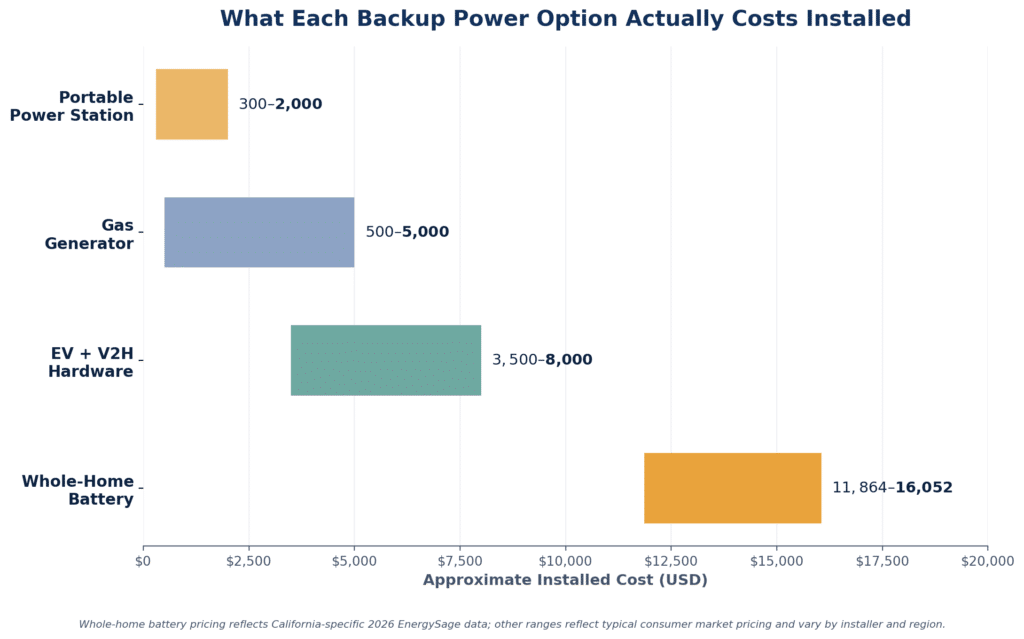
Best overall. A home battery, ideally paired with solar, wins on every safety criterion that matters during wildfire conditions: no exhaust, no fuel, no fire-spark risk, and it can be left running unattended if you need to evacuate. It switches on automatically within milliseconds of a grid outage. According to 2026 EnergySage data for California, a typical 13 kWh system installed runs $11,864 to $16,052. The tradeoff is cost, this is the most expensive option upfront, though it’s also the only one that keeps working, and keeps recharging, for as long as a multi-day PSPS event lasts.
#2: EV with Vehicle-to-Home (V2H) Backup Power
Best if you already own, or are shopping for, a compatible EV. This is the newest entry on this list, and it’s a legitimate one now. A modern EV battery holds roughly 60 to 130 kWh, compared to 13 to 15 kWh for a typical home battery, meaning a single charged EV can carry the equivalent of five or more Powerwalls. The Ford F-150 Lightning’s Intelligent Backup Power system can deliver up to 9.6 kW continuously, enough to run a home for two to three days on a full charge. Kia’s EV9, GM’s Ultium lineup (Silverado EV, Blazer EV, Equinox EV, and others), and Tesla’s Cybertruck via Powershare all support similar setups with the right hardware.
Two real caveats worth knowing before counting on this option: first, it requires a bidirectional charger and, for most systems, a transfer switch or home integration panel, running roughly $3,500 to $8,000 installed depending on the vehicle and hardware, Tesla’s Cybertruck Powershare tends to be the cheapest path in. Second, the market is moving fast and not always forward: Ford discontinued its Charge Station Pro, the hardware new Lightning home-backup setups depended on, in 2026. If you’re considering V2H, verify current hardware availability for your specific vehicle before assuming a past review still applies.
#3: Portable Power Station (With a Solar Panel Add-On)
Best budget option, or a solid backup-to-the-backup. A large battery pack with built-in outlets, typically 1 to 3 kWh, running $300 to $2,000 depending on capacity. Safe in terms of fire and carbon monoxide risk, and genuinely portable, you can take it with you if you evacuate, which nothing else on this list offers. The real limitation is capacity and manual operation: it doesn’t wire into your panel, doesn’t switch on by itself, and without an add-on solar panel it can’t recharge once depleted during an outage. Good for a single room, medical device, or as a mobile supplement; not a substitute for whole-home coverage during a multi-day event.
#4: Gas or Propane Generator, Use With Real Caution
Ranked last specifically for wildfire conditions, not because it doesn’t work. A generator offers real power and relatively low upfront cost, $500 to $5,000 depending on size, but it’s the only option on this list with a documented death toll attached to its use: the CPSC links portable generators to more than 100 carbon monoxide deaths a year, and PGMA-referenced safety guidance requires a 5-foot cleared radius around the unit specifically because hot engine surfaces can ignite dry vegetation, the exact conditions present during a PSPS. It also can’t be left running safely if an evacuation order arrives. We cover both risks in detail in What Is a Public Safety Power Shutoff? If you already own a generator, that guide covers how to use it as safely as possible; it’s not a reason to avoid backup power altogether, just a reason to rank it last among the real alternatives.
FAQs
What’s the safest backup power option during wildfire season?
A whole-home or critical-loads battery, ranked #1 above. Among the four real options, it’s the only one with no exhaust, no fuel storage, no fire-spark risk, and no manual intervention required if you need to evacuate suddenly.
Why are generators risky to use during a wildfire evacuation warning?
Two documented risks: carbon monoxide poisoning, linked to over 100 deaths a year by the CPSC, and fire ignition from hot engine surfaces near the dry, windy conditions that define PSPS-triggering weather. A running generator also can’t be safely abandoned if an evacuation order arrives, unlike every other option on this list.
Can a home battery system run air filtration during smoke events?
Yes. A HEPA air purifier typically draws 40 to 100 watts, a small addition on top of a critical-loads setup already running your refrigerator and communication devices. An EV in V2H mode has even more headroom given its much larger capacity.
How does whole-home battery backup compare to portable power stations?
Home batteries hold roughly 5 to 10 times the capacity, wire directly into your panel to switch on automatically, and recharge from solar during an outage. Portable power stations are cheaper and genuinely portable, useful if you evacuate, but they’re a single-room supplement, not whole-home coverage. An EV with V2H sits above both in raw capacity but requires dedicated hardware most homes don’t yet have installed.
What backup power systems does HomeLink Solar install for wildfire season?
HomeLink Solar (CSLB License #1117534) designs solar-plus-battery systems sized around your household’s actual critical loads and California wildfire risk, with owner Mandy personally overseeing every install and no subcontractors. See real completed installs on our our installs page, explore no-large-upfront-cost options through our Power Choice Program, or get a free personalized quote.
Related Reading
See How to Prepare for California PSPS Power Shutoffs for trigger conditions and notification timelines, and What Is a Public Safety Power Shutoff? for the full safety case against generators during wildfire conditions. Also see our How Long Can a Home Battery Power Your House?, Power Choice Program, and HomeLink vs. Sunrun.