Short answer: a price range, with the date
A home battery in California costs about $13,482 for a 13 kWh system before incentives, with a typical range of $11,460 to $15,504, based on EnergySage data updated Nov 1, 2026. Pages for the Los Angeles and San Bernardino County areas show slightly higher averages. The federal tax credit no longer applies to systems finished after Dec 31, 2025.
These are market averages, not HomeLink Solar quotes. We price each home by its battery count and setup, so your quote is the number to trust. Below you will find what moves the price, the cost by battery size, the incentives that are left, and what to compare when quotes arrive.
What drives the price
Five things do most of the work in a battery quote.
- Battery size. Cost scales with capacity. EnergySage’s California averages work out to about $1,037 for every kWh of storage, so a bigger battery or a second battery raises the price in a steady line.
- Equipment. EnergySage says the quality of the equipment and the type of inverter both change what a customer pays.
- How much of your home you back up. Tesla describes whole-home backup and partial-home backup, and its Powerwall 3 datasheet lists different hardware for each: a Backup Switch or Gateway 3 for the whole home, a Backup Gateway 2 for a partial home. A larger backup scope can mean more equipment and more battery.
- Installation, permits and panel work. The labor to mount and wire the battery, the permit and the utility paperwork are part of getting a system approved and running. An older electrical panel can need work before a battery connects.
- New solar or existing solar. A battery installed with new panels is priced differently from one added to a system you already own. We cover that case in how to add a battery to existing solar in California.
Cost by battery size
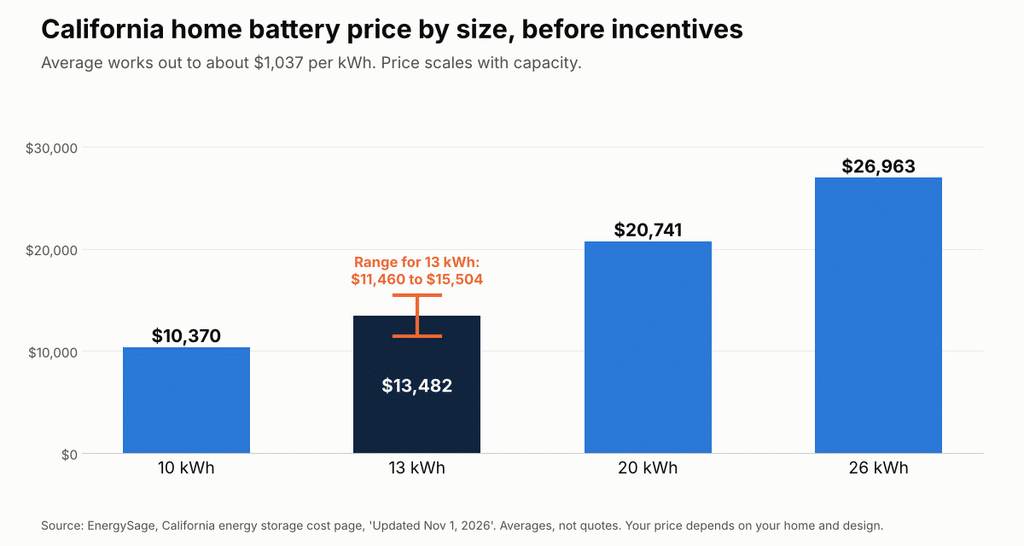
EnergySage lists California averages for four battery sizes. The figures are before any incentives. EnergySage describes the 13 kWh figure as the price to install a system in California and does not itemize labor, permits or electrical work.
| Battery size | California average, before incentives | Per kWh |
|---|---|---|
| 10 kWh | $10,370 | $1,037 |
| 13 kWh | $13,482 (range $11,460 to $15,504) | $1,037 |
| 20 kWh | $20,741 | $1,037 |
| 26 kWh | $26,963 | $1,037 |
Source: EnergySage, California energy storage cost page, “Updated Nov 1, 2026.”
Prices also differ a little by area. These are EnergySage’s 13 kWh averages for four Southern California locations, each with its own update date:
| Area | 13 kWh average | Range | Page updated |
|---|---|---|---|
| Mission Hills (Los Angeles County) | $13,963 | $11,869 to $16,057 | Nov 1, 2026 |
| Grand Terrace (San Bernardino County) | $14,107 | $11,991 to $16,223 | Nov 1, 2026 |
| Santa Ana (Orange County) | $13,482 | $11,460 to $15,504 | Oct 4, 2026 |
| Solana Beach (San Diego County) | $13,482 | $11,460 to $15,504 | Oct 11, 2026 |
Treat the spread as a guide. A 13 kWh size is close to one Tesla Powerwall 3, which Tesla rates at 13.5 kWh nominal energy. Two batteries put you near the 26 kWh row. To see how much each size can run in an outage, read what a Powerwall 3 can run during an outage.
Two batteries cost about twice as much as one in these averages, because EnergySage’s figures scale with capacity. In a real quote, the second battery may cost less than the first, since some of the labor, the permit and the backup equipment are shared.
Incentives and tax credit status
This is the part that changed most. Check the date on this page, because program budgets move.
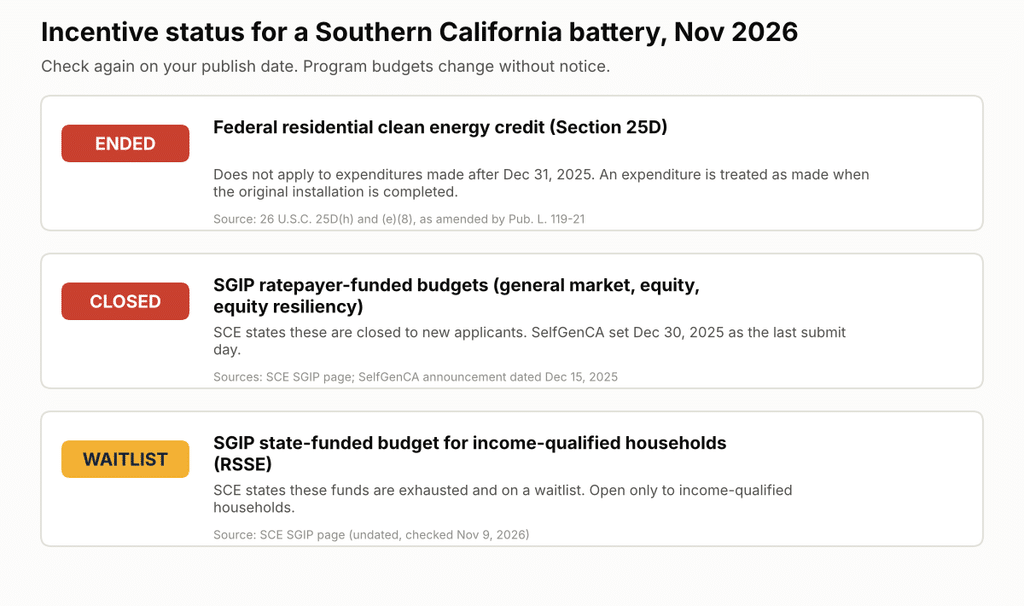
Federal tax credit. The residential clean energy credit, Section 25D of the tax code, does not apply to “any expenditures made after December 31, 2025.” The law treats an expenditure as made when the original installation is completed. A battery that finished installation in 2026 or later does not qualify. Tax rules can differ if a company, not the homeowner, owns the system, and we are not tax advisors, so ask a tax professional about your case.
SGIP, California’s battery rebate. The Self-Generation Incentive Program paid rebates per kWh of storage. On Southern California Edison’s SGIP page, the ratepayer-funded budgets are “now closed to new applicants,” and the state-funded budget for income-qualified households has been exhausted and is on a waitlist. SelfGenCA, the program’s statewide site, gave Dec 30, 2025 as the last day to submit for the ratepayer budgets. SCE’s page shows no update date, and we checked it on Nov 9, 2026.
For budgeting, plan on the full price. Count a rebate only after it is confirmed in writing for your address, before you sign anything.
Some rebate programs run through a city or a community choice energy provider. We do not list them here, because we cannot verify them for every Southern California utility. Ask us what applies to your address.
Power Choice and Solar Plus programs
HomeLink Solar offers Power Choice for Southern California Edison customers and Solar Plus for San Diego Gas & Electric customers.
Whatever the program, ask for the same things on paper: the battery size in kWh, the number of batteries, what is backed up, and the total price.
Is it worth it? What to compare
We will not promise a payback period in a blog post. Whether a battery pays for itself depends on your rate plan, your usage and how often the power goes out, and a fair estimate needs your bills. What we can give you is a way to compare quotes on equal terms. Outages are the other half of the value. The U.S. Department of Energy says grid-tied solar switches off during an outage, while solar plus storage can deliver power at night, so a battery is what keeps a solar home running when the grid is down.
- Price per kWh. Divide the quote by the battery’s kWh. For example, $15,000 for 13.5 kWh is about $1,111 per kWh. Compare that with the $1,037 average above, and ask why if it is far off.
- What is included. Equipment, installation, permits, utility paperwork and any panel work should be listed line by line.
- Backup scope. Ask which circuits stay on when the grid is down, and whether it is whole home or partial home.
- Warranty. Tesla’s datasheet lists a 10-year warranty for the Powerwall 3. Ask what the installer adds for workmanship.
- Who does the work. HomeLink Solar’s own crews install every system, under CSLB license #1117534, with no subcontractors. You can check any contractor’s license on the CSLB website.
- Incentives in writing. Ask the installer to state which incentives apply and as of what date.
For the full picture, read our complete guide to solar battery backup in Southern California. Get your exact price.
FAQs
How much does home battery backup cost in Southern California?
EnergySage’s California average is $13,482 for a 13 kWh battery before incentives, with a range of $11,460 to $15,504, as of Nov 1, 2026. HomeLink prices by home and battery count, so your quote will differ. Use the average as a check, not a promise.
What changes the price of a home battery?
Battery size and count, equipment, how much of the home is backed up, installation and permit work, and whether you are adding to existing solar.
Is there a federal tax credit for a home battery?
Not for new installations. The residential clean energy credit does not apply to expenditures made after Dec 31, 2025, and an expenditure is made when installation is completed. Ask a tax professional about your own situation.
Is the SGIP battery rebate still available?
For most homeowners, no. Southern California Edison states its ratepayer-funded SGIP budgets are closed to new applicants, and the state-funded budget for income-qualified households is on a waitlist. Check the date on this page and the program’s own site before you plan around a rebate.
Can I add a battery to solar I already have?
It depends on your existing system. Our guide on adding a battery to existing solar walks through what to check.
Sources
- EnergySage: Energy storage cost in California, “Updated Nov 1, 2026,” read Nov 9, 2026
- EnergySage: Mission Hills (Nov 1, 2026), Grand Terrace (Nov 1, 2026), Santa Ana (Oct 4, 2026), Solana Beach (Oct 11, 2026)
- 26 U.S.C. 25D, subsections (h) and (e)(8), as amended by Public Law 119-21, read Nov 9, 2026
- Southern California Edison: Self Generation Incentive Program, undated page, read Nov 9, 2026
- SelfGenCA: Statewide Announcements, notice dated Dec 15, 2025, read Nov 9, 2026
- U.S. Department of Energy: Solar and Resilience Basics
- Tesla: Powerwall 3 Datasheet, North America (2024)