Short answer: can you add a battery to existing solar?
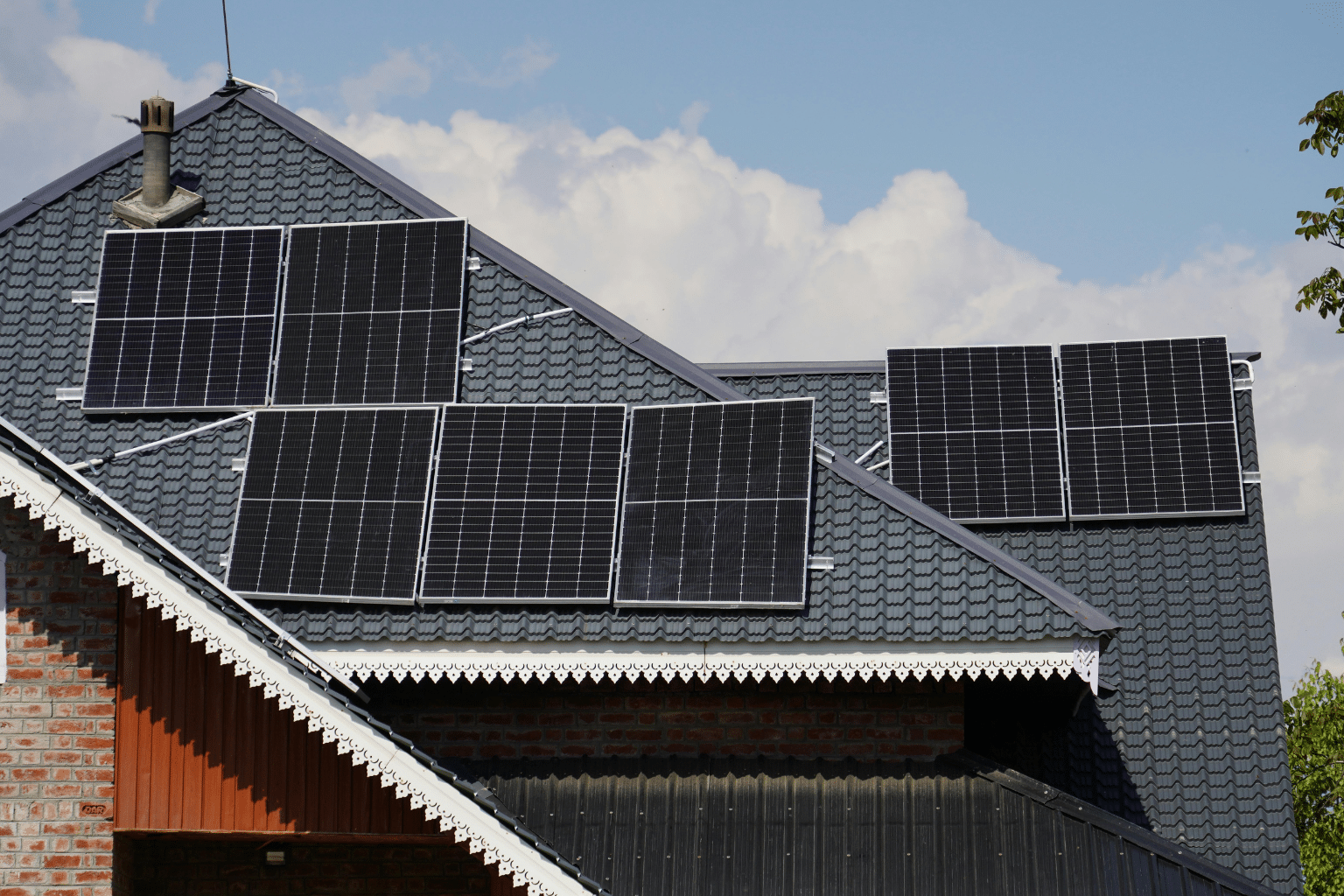
In many cases, yes. You can often add a battery to solar you already own, but how well it works depends on your inverter, your system’s age and your electrical panel. A battery gives you backup power when the grid goes down. HomeLink Solar checks those three things before we quote, so you know what is possible first.
Why add a battery to solar you already own?
Because panels alone shut off during a power outage. Most home solar systems are built to switch off when the grid goes down, so a system without a battery gives you nothing in a blackout, even in full sun. We explain why in Do Solar Panels Work During a Power Outage?
In Southern California, outages are not only about storms. SCE sometimes shuts off power on purpose during high winds to reduce wildfire risk, and it says a shutoff may last over 24 hours. EnergySage says one battery paired with solar can typically keep essentials like a refrigerator, a Wi-Fi router and a few lights running for a day or two. A battery will not match every home’s needs, but it changes what an outage looks like. See what happened in the October 2026 shutoffs for a recent example.
What decides whether your system can take a battery
We cannot promise that every system can take a battery, and neither can anyone else without looking at it. These are the things that decide it.
- Your inverter. The inverter converts the power your panels make into the electricity your home uses. Its type and age shape which battery designs work with it.
- Your system’s age. Older equipment can limit which batteries connect cleanly.
- Your electrical panel. Backup power runs through your panel. Tesla’s partial-home designs add a separate backup panel for the circuits you want kept on, so the layout of your panel matters.
- What you want to back up. Whole home backup needs more battery than backing up a few circuits, such as the fridge, lights and internet.
HomeLink Solar reviews these before quoting.
Retrofit options: AC-coupled vs DC-coupled
These two terms describe how a battery connects to your panels. Here is the plain version, based on EnergySage’s explanation.
| AC-coupled | DC-coupled | |
|---|---|---|
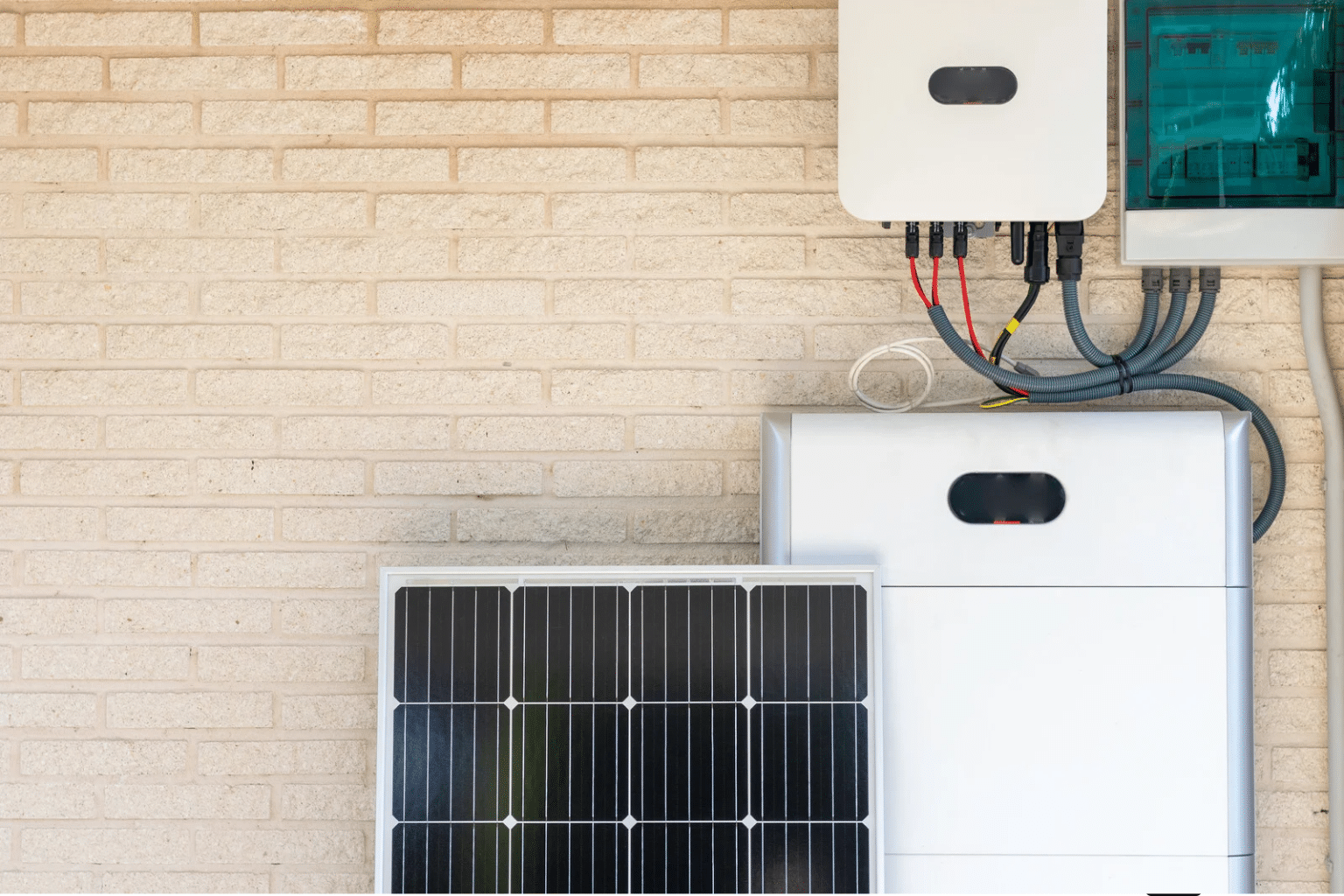
| How it connects | Your panels feed your solar inverter. The battery connects through its own inverter. | One hybrid inverter serves both the panels and the battery. |
| For an existing system | EnergySage says AC-coupled batteries are often best when adding a battery to an existing solar system. | EnergySage says DC-coupled options are more complicated to install as a retrofit. |
| Cost and time | EnergySage calls AC retrofits relatively easy and affordable, since they need less labor. | Retrofits can raise upfront cost and install time. |
| Trade-off | Two inverters means more hardware. Power is converted more times before the battery. | One inverter can lower hardware costs on a new installation. |
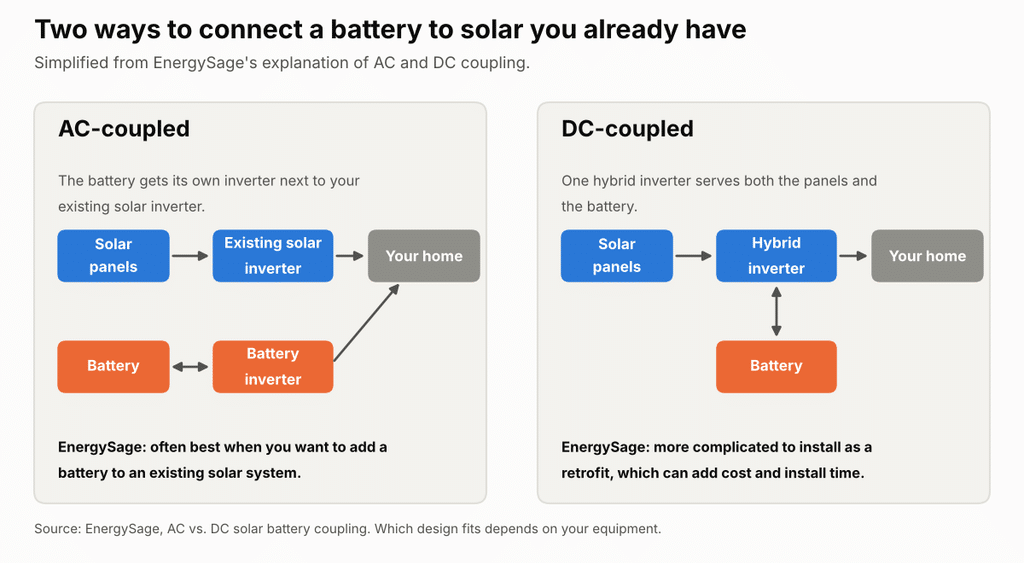
Tesla’s batteries add a wrinkle. Not a Tesla App reports that Powerwall 2 relied on AC coupling and external solar inverters, while Powerwall 3 has an integrated solar inverter. So which design fits your home depends on your equipment, and your installer should say which one they plan to use and why. [CONFIRM: which batteries HomeLink installs as retrofits, and how.]
Permits and utility approval (SCE and SDG&E)
Adding a battery usually involves two sets of approvals: your city or county, and your utility.
- Local permit. Your local permitting office sets the requirements for the install, and your installer is responsible for contacting them and securing the permits, according to Solar United Neighbors.
- Utility review. Some utilities require interconnection review and approval on top of local permits. SCE and SDG&E each have their own process, and your installer handles the paperwork. [CONFIRM: current SCE and SDG&E steps for adding storage to an existing system.]
- Safety listing. The Center for Sustainable Energy recommends UL 9540-listed equipment as a baseline for safety. UL 9540 is the safety standard for energy storage systems.
Do not turn a battery on before your utility approves it. Ask your installer to confirm the approval in writing.
Cost: what to expect
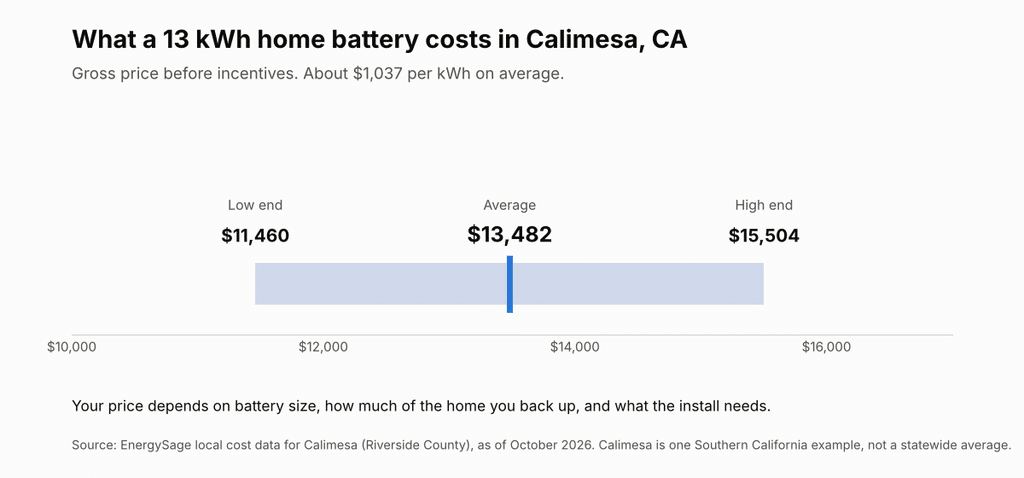
EnergySage’s local data for Calimesa, in Riverside County, lists an average gross price of $13,482 for a 13 kWh battery as of October 2026, within a range of $11,460 to $15,504. That works out to about $1,037 per kWh, before incentives. Calimesa is one Southern California example, so your price will differ.
What moves the price:
- Battery size and number. EnergySage says whole-home backup generally takes two or more batteries.
- How much you back up. Backing up selected circuits needs less than the whole home.
- Retrofit complexity. EnergySage says DC-coupled retrofits can raise upfront cost and install time.
- Electrical work. A panel that needs changes adds to the job.
For more on pricing, see How Much Does Home Battery Backup Cost in Southern California?
Incentives and tax credit status
Federal tax credit. The federal residential clean energy credit has ended for new spending. The IRS instructions for Form 5695 say you cannot claim residential clean energy credits for expenditures made after Dec 31, 2025. A battery installed in 2026 does not qualify. Speak with a tax adviser about your own case.
SGIP, California’s battery rebate. The Self-Generation Incentive Program has residential storage incentives for eligible households. The CPUC lists $1,100 per kWh for storage under its Residential Solar and Storage Equity budget. To qualify, a single-family household generally needs income at or below 80 percent of area median income, or enrollment in programs such as CARE, FERA or ESA. The CPUC’s fact sheet bases eligibility on those criteria, not on whether you already have solar. Funding is limited and some customers may be waitlisted, so check current availability before you count on it. You apply through your utility’s program administrator: SCE for SCE customers, and the Center for Sustainable Energy for SDG&E customers. [CONFIRM: SGIP budget status on the publish date.]
Programs: Power Choice (SCE) and Solar Plus (SDG&E)
HomeLink Solar offers Power Choice in SCE areas and Solar Plus in SDG&E areas, which pair solar with a Tesla Powerwall 3. [CONFIRM on both program pages: what each program includes, who qualifies, and whether either applies to homeowners who already have solar. If not, add one line saying these programs are for new systems and a retrofit is quoted separately.]
How long the install takes
A battery retrofit has several stages: a system review, design, permits, installation, utility approval and switching on. Our own crews do the work, with no subcontractors.
What to have ready for a retrofit quote
- The make and model of your solar inverter (it is printed on the unit).
- The year your solar was installed.
- A photo of your main electrical panel.
- A recent utility bill.
- What you want backed up: the whole home, or a few essential circuits.
HomeLink Solar’s in-house crews do the installation, under CSLB license #1117534. Already have solar? Get a retrofit quote.
Want to know what a battery can run once it is in? Read What Can a Powerwall 3 Run During an Outage? For the full picture, see our complete guide to solar battery backup in Southern California.
FAQs
Can you add a battery to existing solar?
In many cases, yes. It depends on your inverter, system age and electrical panel. HomeLink reviews these before quoting.
Can you add a Tesla battery to existing solar?
Often, but how it connects depends on your existing equipment. Powerwall 3 has its own built-in solar inverter, so we confirm the setup that fits your system before we quote.
How much does it cost to add a battery in California?
EnergySage lists an average of $13,482 for a 13 kWh battery in Calimesa, with a range of $11,460 to $15,504, before incentives (as of October 2026). Your price depends on battery size and install needs.
Do I need a permit to add a battery?
Yes, expect a local permit, and possibly utility approval. Your installer is responsible for securing the permits.
Is there a federal tax credit for a home battery?
No, not for spending after Dec 31, 2025, according to the IRS instructions for Form 5695. Check with a tax adviser for your case.
Sources
- EnergySage: Do Solar Panels Work During a Power Outage?
- Southern California Edison: Public Safety Power Shutoffs (checked Oct 21, 2026)
- EnergySage: Storage cost in Calimesa, CA (updated Oct 18, 2026)
- EnergySage: AC vs. DC solar battery coupling
- IRS: Instructions for Form 5695 (2025)
- CPUC: Self-Generation Incentive Program
- CPUC: SGIP fact sheet, Residential Solar and Storage Equity
- Not a Tesla App: Tesla Expands Powerwall 3 Backwards Compatibility to North America (Sep 23, 2026)
- Tesla Support: Powerwall System Design
- Center for Sustainable Energy: A Practical Guide to Improve Permitting for Battery Energy Storage Systems
- Solar United Neighbors: Will I need a permit to install a battery? What about my utility?