Short answer
One Powerwall 3 can run the essentials in most homes, such as the refrigerator, lights, Wi-Fi and phone charging, for most of a day. It can also run a central air conditioner for a few hours. Tesla rates it at 13.5 kWh of energy and 11.5 kW of continuous power.
Two numbers decide everything. Power, in kilowatts, sets what can run at the same time. Energy, in kilowatt-hours, sets how long it keeps running. Whether it covers your whole home depends on how the system is installed.
What a Powerwall 3 is
The Powerwall 3 is Tesla’s home battery with a built-in solar inverter. Here are its specs from Tesla’s 2024 Powerwall 3 datasheet for the United States, read on Nov 5, 2026:
| Spec | What Tesla lists |
|---|---|
| Nominal energy | 13.5 kWh AC (at 25°C, beginning of life) |
| Continuous power | 11.5 kW AC discharge, which may be de-rated above 40°C (104°F) |
| Motor start | 185 A LRA for 1 second |
| Maximum continuous current | 48 A |
| Solar input | Up to 20 kW STC, with 6 solar inputs (MPPTs) |
| Units per home | Up to 4 Powerwall 3 units supported |
| Backup options | Whole home with a Backup Switch or Gateway 3. Partial home with a Backup Gateway 2. |
| Warranty | 10 years |
Tesla lists nominal energy, not usable energy. That is why the math below uses 13.5 kWh and flags the limits.
What a Powerwall 3 can run: appliance table
Tesla groups home loads into two types. Its 120 V loads are “lights, plugs and small appliances.” Its 240 V heavy loads include “air conditioners, electric cooking ranges, well pumps, EV charging, electric dryers, electric water heaters and pool pumps.” The watts below come from the U.S. Department of Energy and the U.S. Energy Information Administration (EIA).
| Appliance | Typical watts | One Powerwall 3? |
|---|---|---|
| Wi-Fi router and modem | 11 W | Yes, for days |
| Laptop | 19 W | Yes |
| CFL bulb (60 W equivalent) | 18 W | Yes |
| Television | 81 W | Yes |
| Refrigerator-freezer | 300 to 500 W while running | Yes |
| Microwave | 1,230 W | Yes, in short bursts |
| Window air conditioner (9,000 BTU) | 1,050 W | Yes, but it drains the battery |
| Central air conditioner (2.5 ton) | 3,500 W | Yes by power. It drains the battery in hours. Ask your installer to check its start current. |
| Electric water heater | 3,800 W | Yes by power, if it is on the backed-up circuits |
| Electric dryer | 5,000 W | Yes by power, if it is on the backed-up circuits. Not alongside the air conditioner and water heater. |
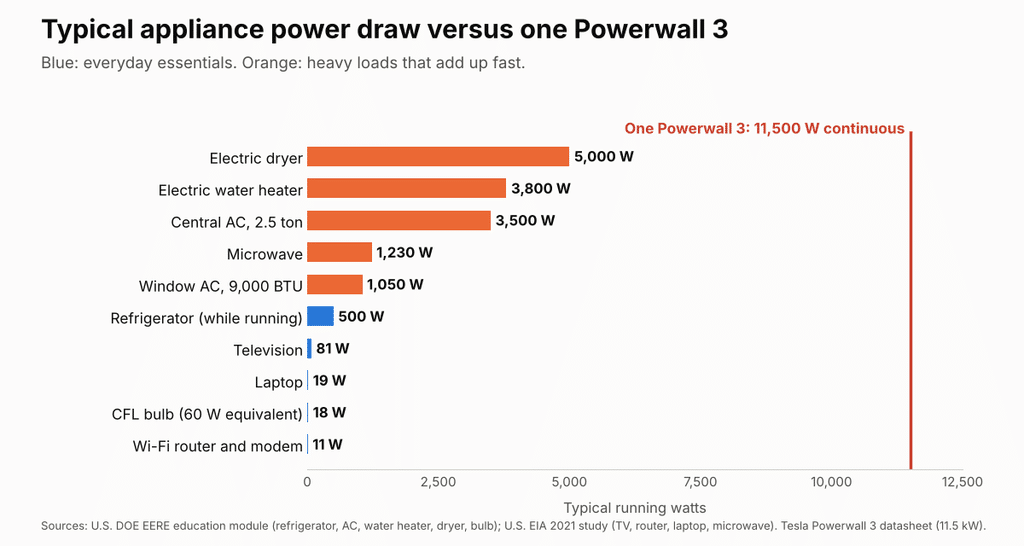
Tesla’s datasheet rates the Powerwall 3 to start motors up to 185 A LRA. LRA is the surge a motor draws for a moment when it starts, and it is printed on your air conditioner’s nameplate. Ask your installer to check yours. Tesla’s pages do not say which heavy loads a given number of Powerwalls supports.
Power adds up. A 2.5-ton central air conditioner, an electric water heater, an electric dryer and the essentials together draw about 13,000 W. That is more than the 11,500 W one Powerwall 3 can deliver, so a second unit or some load management is needed.
Whole-home vs partial backup
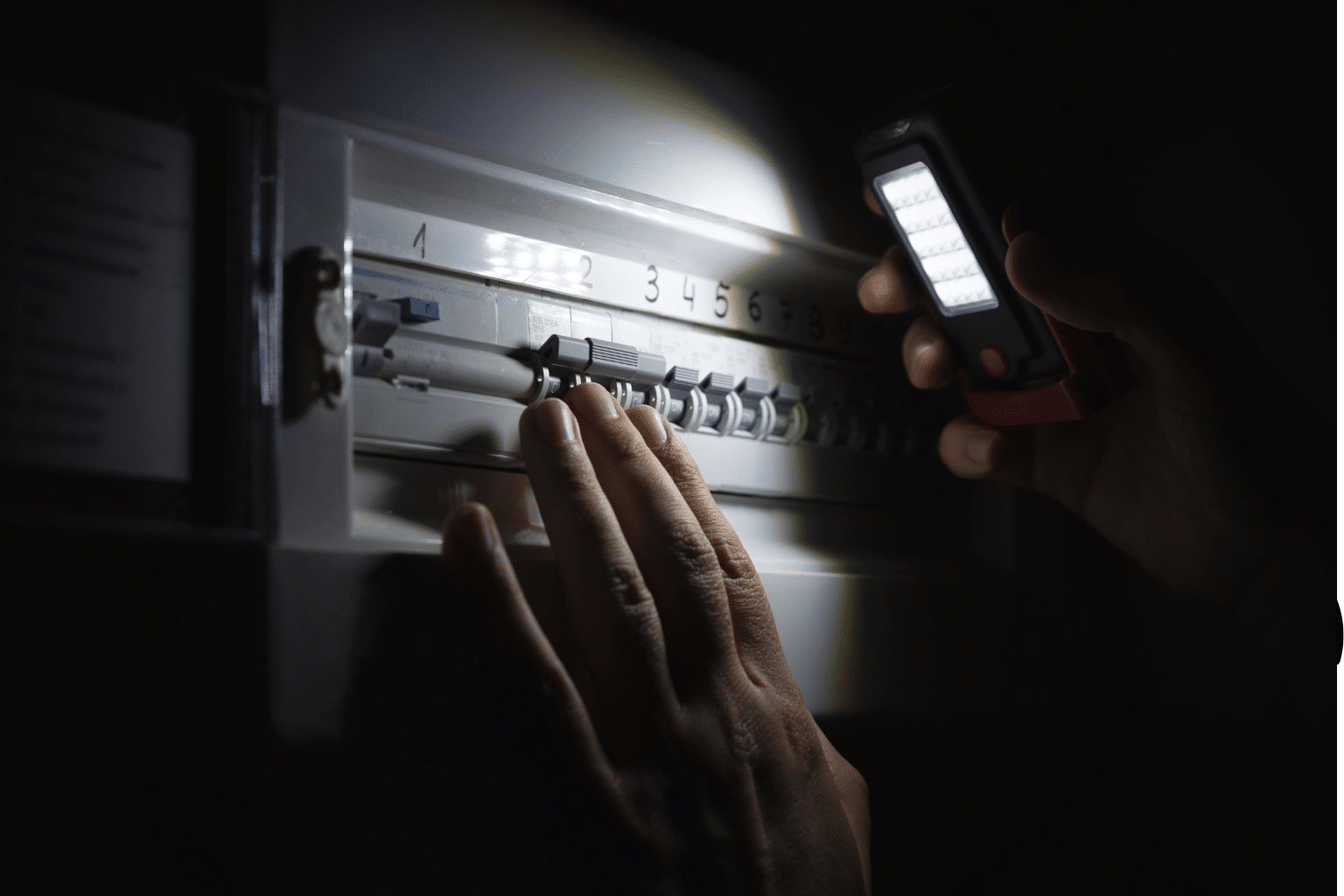
Tesla describes two setups. With whole-home backup, “your Powerwall will be able to support your entire home including all appliances during a power outage.” With partial-home backup, you choose essential loads such as lights and outlets and leave out heavier loads. Tesla gives air conditioners and washing machines as examples. When the grid is down, “only the loads you deem essential will be usable.”
The datasheet ties this to the hardware: whole home with a Backup Switch or Gateway 3, and partial home with a Backup Gateway 2.
One battery vs two
Runtime is the battery’s energy divided by your load. Here is the math, using 13.5 kWh per Powerwall 3 and assuming every load runs nonstop, which is the worst case:
- Essentials: refrigerator 500 W, router 11 W, television 81 W, laptop 19 W and five bulbs at 18 W each (90 W) add up to 701 W.
- Essentials plus a central air conditioner: 701 W plus 3,500 W is 4,201 W.
| Load | One Powerwall 3 (13.5 kWh) | Two Powerwall 3 (27 kWh) |
|---|---|---|
| Essentials, 701 W | 13.5 kWh / 0.701 kW = 19.3 hours | 27 kWh / 0.701 kW = 38.5 hours |
| Essentials plus central AC, 4,201 W | 13.5 / 4.201 = 3.2 hours | 27 / 4.201 = 6.4 hours |
| Central AC alone, 3,500 W | 13.5 / 3.5 = 3.9 hours | 27 / 3.5 = 7.7 hours |
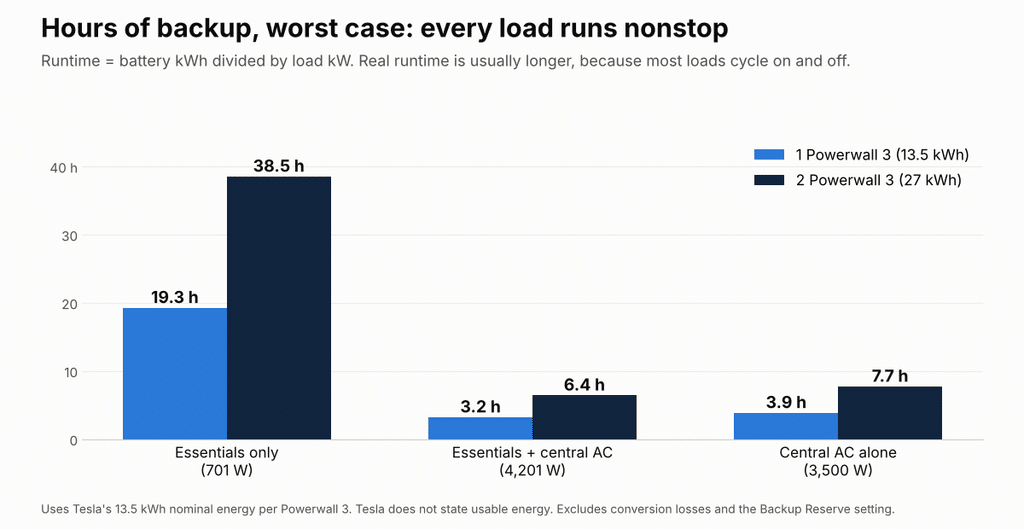
Real runtime is usually longer, because refrigerators and air conditioners cycle on and off. It can also be shorter, because the table ignores conversion losses and your Backup Reserve setting. Tesla’s app lets you hold back 0 to 80 percent of the battery for outages, and “Max Backup” temporarily sets it to 100 percent for up to 72 hours. Raising it before a storm gives you more to use in an outage.
A second battery does two things. It doubles the energy, to 27 kWh, and it doubles the power, to about 23 kW. Tesla’s datasheet supports up to four Powerwall 3 units. The right number depends on your loads, so our guide on how long a home battery can power your house and our battery backup cost guide walk through the trade-off.
How solar recharges it
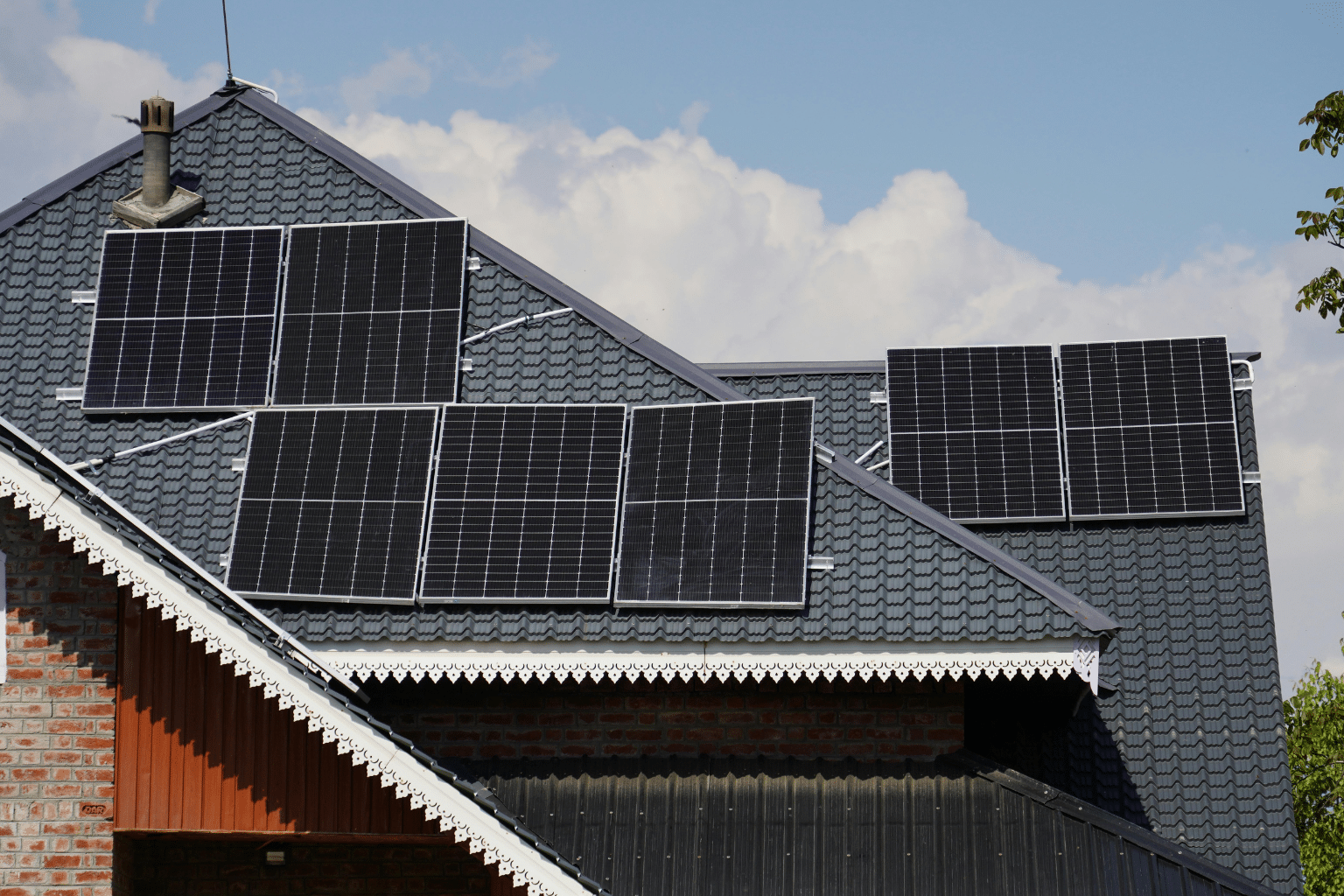
If your Powerwall is paired with solar, it can recharge from your panels when the grid is down. Tesla says that if an outage starts with the battery below 5 percent, power to your home is lost at first. The Powerwall then waits to recharge from solar the next morning, and it periodically powers your home until solar output can cover both household use and recharging.
That is why a sunny day matters. The battery covers the night, and the panels carry the load and refill the battery the next day. Without solar, a battery has nothing to refill it until the grid returns. Panels with no battery stop working when the grid goes down. We explain why in Do Solar Panels Work During a Power Outage?
HomeLink Solar’s Power Choice program pairs solar with a Tesla Powerwall 3. Our own crews do the installs, under CSLB license #1117534. For the full picture, read our complete guide to solar battery backup in Southern California. See what your home needs.
FAQs
What can a Powerwall 3 run during an outage?
Tesla lists lights, plugs and small appliances as 120 V loads, and heavier 240 V loads such as air conditioners, dryers, water heaters and EV charging. One Powerwall 3 delivers up to 11.5 kW continuously. What runs at once depends on that limit, and which loads are backed up depends on whether your home has whole-home or partial backup.
How long will a Powerwall 3 last in an outage?
It depends on what you run. At 13.5 kWh, a load of 701 W for essentials lasts about 19 hours in the worst case, and a 3.5 kW central air conditioner alone lasts about 4 hours. Divide the battery’s kWh by your load in kW to check your own numbers.
Can a Powerwall 3 run my air conditioner?
By power, yes. A typical 2.5-ton central air conditioner draws about 3,500 W, well under 11,500 W. Tesla rates the Powerwall 3 to start motors up to 185 A LRA, so check your unit’s nameplate and ask your installer. An air conditioner will drain a single battery in hours, not days.
Does a Powerwall 3 work at night?
Yes. It runs your home from stored energy at night. If you have solar, the panels can recharge it the next day, even during an outage.
How many Powerwall 3 batteries do I need?
One covers essentials for most of a day. Two double both the runtime and the available power, and help if you want heavy loads like air conditioning, a water heater or a dryer backed up. Tesla suggests asking a certified installer for a final recommendation.
Will a Powerwall charge during a power outage?
Yes, if it is paired with solar. Tesla says the Powerwall can recharge from solar the next morning and carry household use once solar output is high enough.
- Tesla: Powerwall 3 Datasheet, North America
- Tesla Support: What Can Powerwall Back Up
- Tesla Support: Backup Reserve,
- U.S. Department of Energy, EERE: Energy Efficiency in the Home, Standard Appliance Energy Consumption data sheets
- U.S. Energy Information Administration: Miscellaneous Electric Load Consumption Characterization, 2021 Update