What forecasters expect this winter
NOAA’s winter outlook points to wetter-than-average conditions across the southern U.S., including California, while a strong-to-very-strong El Niño is likely through January to March 2027. Although these forecasts don’t predict power outages, winter storms can still disrupt electricity across Southern California. Here’s what homeowners should know about potential power outages and how to prepare before the next storm.
Here are the figures. In its Oct 8, 2026 discussion, the Climate Prediction Center put the chance of a strong-to-very-strong El Niño through January to March 2027 at greater than 83%. NOAA’s 2026-27 Winter Outlook, released Oct 15, says “wetter-than-average conditions likely across the southern U.S., from California to Florida” for December to February. Ken Graham, director of the National Weather Service, said a very strong El Niño “will likely bring a southward and eastward shift to the jet stream.”
These are odds, not promises. The Climate Prediction Center says the chances of El Niño impacts are “larger, though not guaranteed.” NOAA also notes that “too much precipitation on dry soil can fuel destructive flash floods and mudslides.” We are not forecasting outages. We are saying a wet winter is a good reason to get ready, the way you would before any storm season.
Storm outages vs wildfire shutoffs: how they differ
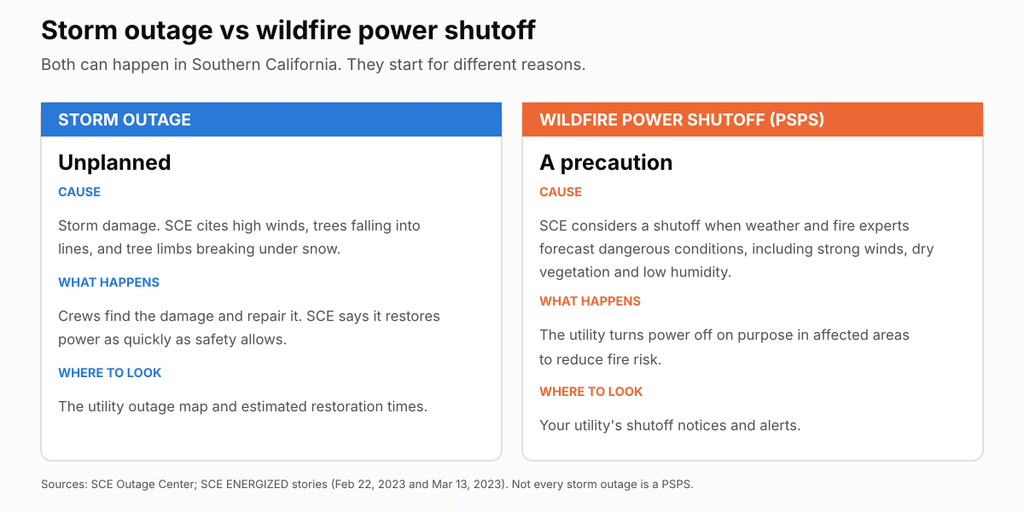
A storm outage is unplanned. Wind, falling trees and the weight of rain or snow damage the lines, and crews repair them. SCE’s storm updates point to the same causes again and again. After a February 2023 storm, high winds toppled a pine tree in Torrance, and about 442 customers lost power. In March 2023, an SCE field supervisor said, “There are a lot of trees coming down.”
A wildfire power shutoff is a different thing. It is a precaution, not damage. SCE says it “will consider a Public Safety Power Shutoff when weather and fire experts forecast dangerous conditions, including strong winds, dry vegetation and low humidity.” A wet storm is a different setup, so this article is about storm outages. If you want the shutoff side, read our guides to SCE power shutoffs and SDG&E power shutoffs.
How to prepare your home
You do not need a long list. Start with the habits SCE and SDG&E both recommend:
- Freeze water now. SCE suggests freezing water and moving it to the refrigerator during an outage to help keep food cold. Keep the doors closed, as SDG&E advises.
- Use flashlights, not candles. SDG&E asks customers to avoid candles during an outage.
- Protect your electronics. SCE recommends surge protectors, and SDG&E suggests turning off major appliances that were running, so they do not all start at once when power returns.
- Learn your garage door release. SCE says to learn how to open automatic garage doors and gates by hand.
- Never run a generator indoors. SCE says portable generators must stay out of enclosed spaces.
- Plan for everyone in your home. SCE advises a family plan that covers infants, older adults, people with disabilities and pets. If someone relies on medical equipment, SDG&E advises having a backup plan, and SCE has a Critical Care Backup Battery Program for those customers.
- Secure loose items outside. SDG&E says tarps and pool covers can tangle in power lines during high winds.
Treat any downed line as live. Stay away, and call 911 and your utility. For a full list, use our ultimate home emergency checklist and our California power outage checklist. To keep food safe, see how refrigerators handle extended power outages.
What a solar battery does on cloudy days
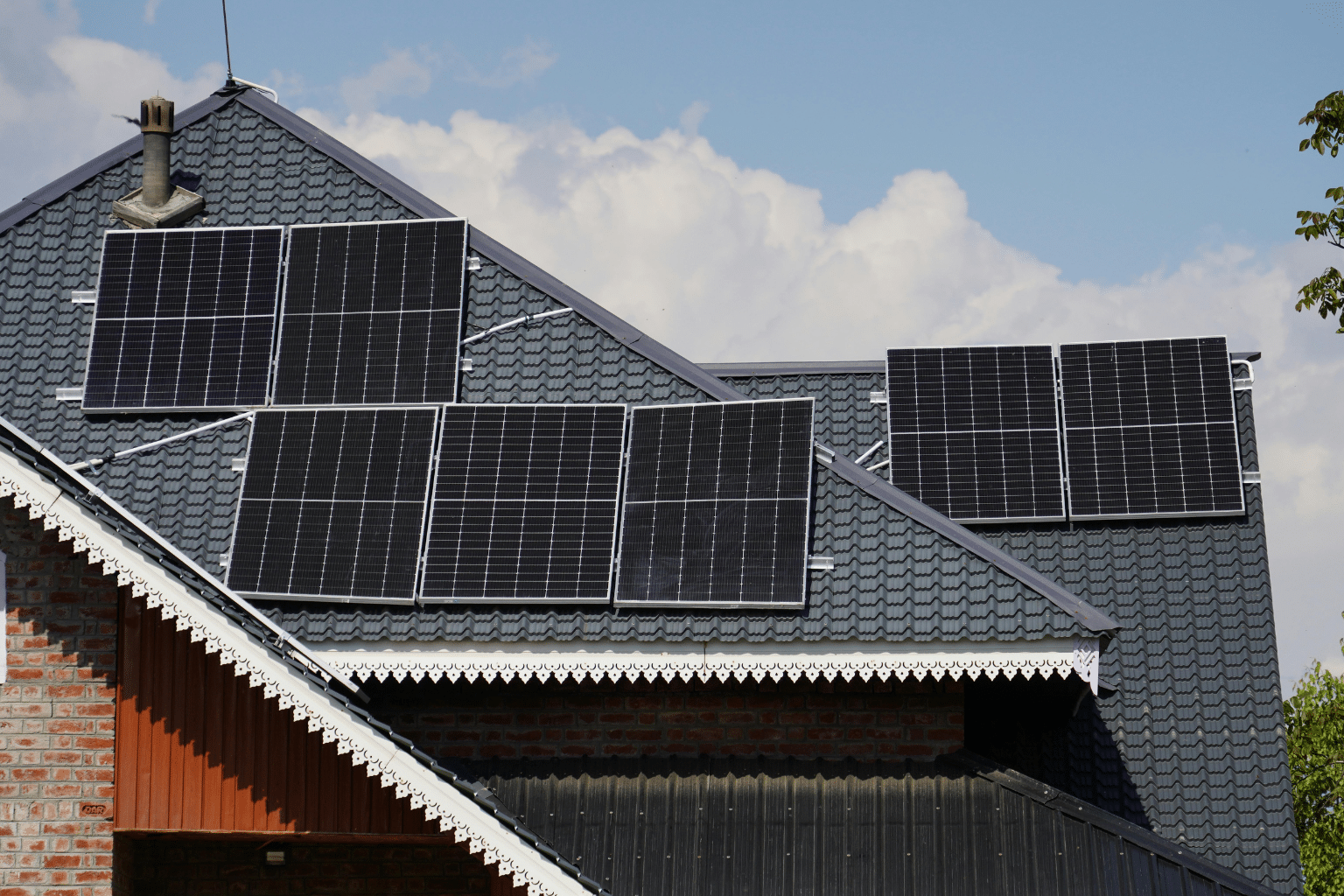
A solar battery keeps your home running when the grid goes down, and with solar panels it can refill from the sun. On a cloudy day, it refills less. Tesla says that “clouds block sunlight from reaching your solar system, significantly reducing production,” and that a typical system in winter produces “closer to 50% of its power potential at noon, versus up to 100% in summer.”
So the plan is simple. Start the storm with a full battery, and use what it holds with care. Here is what Tesla’s support pages say about the Powerwall:
- Recharging. With solar installed, “Powerwall can recharge from your solar system.” In standby, it “will automatically attempt to recharge from solar every hour between 8 AM and 4 PM local time.” Tesla notes that some weather can reduce solar production.
- Backup Reserve. You can set a reserve anywhere from 0% to 80%. Tesla’s Max Backup setting lets you temporarily set it to 100% for up to 72 hours.
- Storm Watch. When a qualifying severe weather alert is issued for your area, such as a winter storm, high wind or flood warning, a Powerwall with Storm Watch turned on charges to full. Tesla says Grid Charging must be enabled and your phone paired with the Powerwall.
- Stretching the charge. Tesla advises reducing energy-intensive appliances such as air conditioners to extend backup time.
How long a charge lasts depends on what you run. With one Powerwall 3 at 13.5 kWh nominal and an essentials load of 701 W, the worst case is about 19 hours, as 13.5 divided by 0.701 shows. We show the full math and the heavier loads in what a Powerwall 3 can run during an outage. Panels without a battery stop when the grid goes down, as we explain in Do Solar Panels Work During a Power Outage?
HomeLink Solar’s own crews install solar and battery systems, under CSLB license #1117534. If you want to be ready before the next storm, prepare before the storm. For the bigger picture, see our complete guide to solar battery backup in Southern California.
When to expect restoration, and how to check status
Nobody can promise a time before the crews see the damage. SCE says it restores power “as quickly as safety allows,” and it shows estimated restoration times in its outage tool. Two examples from SCE show the range. In January 2022, a snowstorm on a mountain left close to 9,000 customers without power, and restoration took about a week of continuous work, because snow-laden trees and icy roads slowed crews. A single tree in Torrance, on the other hand, affected a neighborhood of about 442 customers.
Use your own utility’s tools:
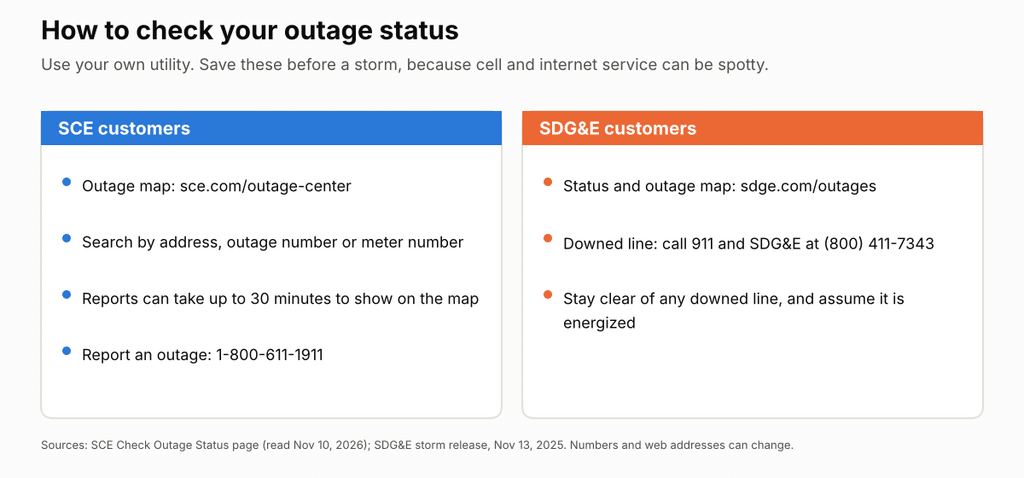
- SCE: the outage map at sce.com/outage-center. Search by address, outage number or meter number. SCE says reported outages can take up to 30 minutes to appear. You can sign up for alerts, and you can report an outage at 1-800-611-1911.
- SDG&E: status updates and the outage map at sdge.com/outages. For a downed line, call 911 and SDG&E at (800) 411-7343.
Save these on your phone before the storm. SCE also warns that “field and weather conditions change regularly,” so map data can lag.
FAQs
Will El Niño cause more power outages?
The forecasts are about weather, not outages. The Climate Prediction Center says a strong-to-very-strong El Niño is likely through January to March 2027, with greater than 83% odds, and NOAA favors a wetter-than-average winter for California. Neither says outages will increase. Storms can still cause them, mostly through wind and falling trees.
How long do storm outages last?
It depends on the damage and on whether crews can get to it. SCE has reported a neighborhood outage from one fallen tree and a mountain storm that took about a week to repair. Check your utility’s outage map for an estimate, and expect it to change.
Does a solar battery recharge on cloudy days?
Yes, but less. Tesla says clouds significantly reduce solar production, and winter systems produce closer to half their potential at noon. A battery that starts the storm full is the best protection.
What should I have ready?
Flashlights, a battery radio, frozen water for the refrigerator, charged phones, and a plan for everyone and every pet in your home. Our ultimate home emergency checklist covers the rest.
Can a Powerwall get ready for a storm by itself?
If Storm Watch is turned on, it charges to full when a qualifying severe weather alert is issued for your area. Tesla says it needs Grid Charging enabled and your phone paired.
Sources
- NOAA Climate Prediction Center: ENSO Diagnostic Discussion, issued Oct 8, 2026, read Nov 10, 2026
- NOAA: El Niño looms large over U.S. Winter Outlook, Oct 15, 2026
- SCE: Check Outage Status, read Nov 10, 2026
- SCE: Outage Center, read Nov 10, 2026
- SCE ENERGIZED: SCE Readies for ‘Biggest Winter Storm in 15 Years’, Feb 22, 2023
- SCE ENERGIZED: Atmospheric Rivers Again Threaten SCE’s Service Area, Mar 13, 2023
- SCE ENERGIZED: SCE Crews Restore Power Amid Intense Mountain Storms, Jan 18, 2022
- SDG&E: winter storm preparation release, Nov 13, 2025
- SDG&E: Staying Safe During Stormy Winter Weather, undated
- Tesla Support: Solar panel system performance, read Nov 10, 2026
- Tesla Support: Best Practices During Power Outages, read Nov 10, 2026
- Tesla Support: Storm Watch, read Nov 10, 2026
- Tesla Support: Backup Reserve, read Nov 10, 2026