Short Answer: Most Systems Keep Working, But Not Forever
A security system power outage does not usually shut your alarm off the moment the lights go out. Nearly every modern security panel ships with a built-in backup battery, so the control panel, keypad, and sensors typically keep running. What changes is how long that protection lasts and how your system talks to the monitoring center or your phone — and that part depends heavily on whether your system uses WiFi, cellular, or a landline connection.
The short version: your panel’s battery is built to outlast a typical outage, but it is not built to outlast a long one, and your internet-dependent features (live video, app alerts, smart locks) can go dark long before the panel’s battery does. Here is exactly what happens, how long you can expect protection to last, and how a home backup power system closes the gap.
How Long Do Power Outages Actually Last in California?
Before looking at battery specs, it helps to know what you are actually planning for. According to the U.S. Energy Information Administration, U.S. electricity customers experienced just over eight hours of power interruptions on average in 2020 when major weather events are included; excluding major events, the annual average from 2013 to 2020 consistently ran around two hours (EIA, 2021). In Southern California, Public Safety Power Shutoffs can extend well beyond that average, sometimes lasting one to several days depending on fire-weather conditions, as we cover in our PSPS preparation guide.
That gap between “typical outage” and “worst-case outage” is exactly why security system battery runtime matters. A panel built to survive a two-hour blip is not necessarily built to survive a three-day shutoff.
What UL and NFPA Actually Require From a Security Panel’s Battery
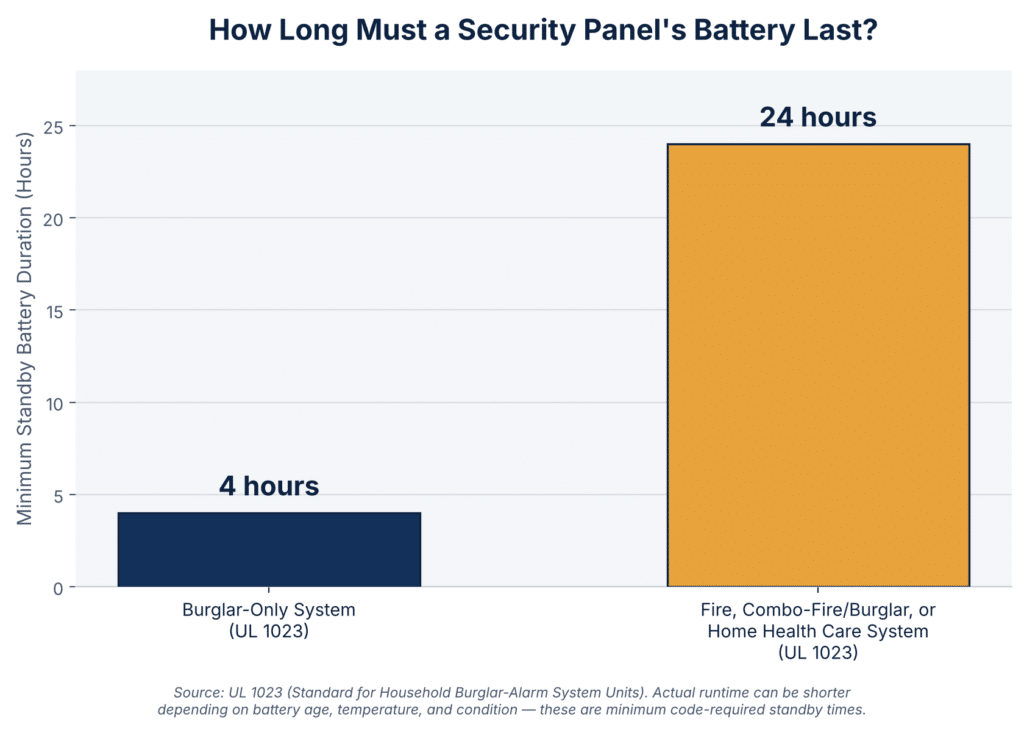
Security system backup batteries are not arbitrary. In the United States, residential burglar-alarm panels are evaluated against UL 1023 (the Standard for Household Burglar-Alarm System Units), which sets minimum standby battery requirements based on what the system protects:
- Burglar-only systems: a minimum of 4 hours of standby battery power.
- Fire, combination fire-burglar, or home health care systems: a minimum of 24 hours of standby battery power.
Systems that include fire detection are held to a stricter standard for good reason, and that stricter logic carries over into commercial fire alarm code as well. NFPA 72 (the National Fire Alarm and Signaling Code), Section 10.6.7.2, requires fire alarm systems to maintain secondary power for a minimum of 24 hours in a non-alarm (quiescent) state, and then be capable of operating all alarm notification devices for an additional 5 minutes at the end of that standby period — or 15 minutes for voice/mass notification systems (National Training Center, NFPA 72 standby battery guidance). NFPA 72 governs fire alarm systems more broadly (including many commercial installations), while UL 1023 is the standard most directly applicable to residential burglar-alarm panels — but both point to the same real-world conclusion: a basic burglar-only panel is engineered for hours, not days.
What Actually Fails First: The Panel, or the Connection?
This is the part most homeowners get wrong. The control panel battery is rarely the first thing to fail during a security system power outage. More often, it is the communication path that goes down first, and which path your system uses determines what you lose and when:
- WiFi-dependent systems (many DIY and app-based security systems) rely on your home router and modem. If your router loses power, the panel can no longer send alerts to your phone or stream live camera video, even if the panel itself is still armed and running on battery.
- Cellular-backup systems use a dedicated cell radio to stay connected to a monitoring center or app independent of your home internet, which is why many providers sell cellular backup as a premium add-on specifically for outage reliability.
- Landline-connected systems can keep communicating during a power outage as long as the phone line itself stays intact, though landline service has become less common in new installations.
In practice, this means two homes with identical “4-hour” battery panels can have very different outage experiences: one keeps sending phone alerts the whole time, and the other goes silent within minutes because its WiFi router has no backup power of its own.
Realistic Runtime: Panel Battery vs. Portable Power vs. Whole-Home Battery
Once you account for the panel, the router, and any cameras or smart locks on the same circuit, the practical runtime of “my security system” during an outage looks different from the UL-minimum number on the box. Here is how three common backup approaches compare:
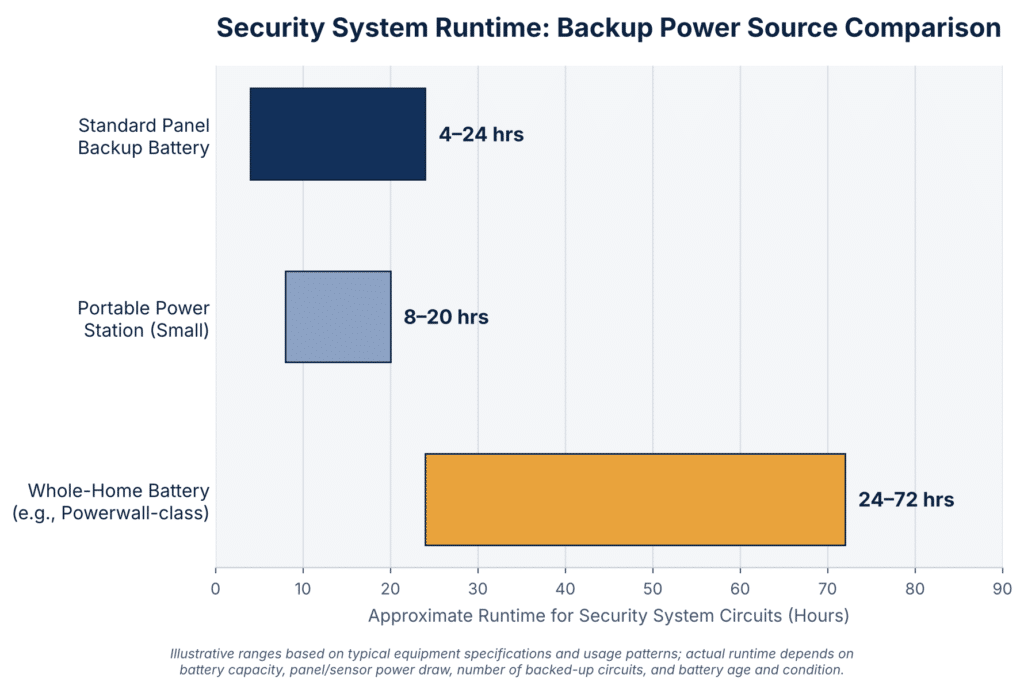
- Standard panel backup battery: typically rated for 4 to 24 hours depending on system type, but this covers only the panel and directly wired sensors, not your WiFi router or cameras.
- Small portable power station: can power a router and a panel’s plug-in transformer for roughly 8 to 20 hours depending on capacity and draw, extending connectivity well past the panel battery alone.
- Whole-home battery system (paired with solar, such as a Powerwall-class battery): can realistically keep security-related circuits — panel, router, modem, cameras, and smart locks — running for 24 to 72+ hours or longer, depending on battery capacity, other household loads, and whether solar is recharging it during the day.
This is the practical argument for pairing a security system with a larger home backup power system rather than relying on the panel’s own battery alone: the panel battery protects the alarm itself, but it was never designed to keep your router, cameras, or smart locks online for a multi-day event.
Steps to Keep Your Security System Protected During the Next Outage
- Check your panel’s battery age. Most alarm panel backup batteries are sealed lead-acid or lithium cells rated for roughly 3 to 5 years of service life. A battery nearing the end of that window may not deliver its full rated runtime even if it tests as “charged.”
- Confirm your communication path. Ask your provider (or check your system documentation) whether your panel relies on WiFi, cellular, or landline, since this determines what else needs backup power to keep you connected.
- Put your router and modem on backup power too. If your system is WiFi-dependent, a panel battery alone will not keep you connected to your phone app once the router loses power.
- Size backup power around your actual critical circuits — panel, router, modem, cameras, and any smart locks — rather than assuming the whole house needs to stay powered.
- Consider whole-home battery backup if you live in a PSPS-prone area. Southern California homeowners dealing with multi-day shutoffs need runtime measured in days, not hours, which a panel battery alone cannot provide.
- Test your system during a planned outage (such as scheduled maintenance) to confirm battery backup, app alerts, and camera access all function as expected before a real emergency arrives.
- Review backup needs alongside other essential circuits in your home, including any medical devices that also require uninterrupted power, so your overall backup plan covers every priority, not just securit
Frequently Asked Questions
Do home security systems have their own battery backup?
Yes. Nearly all modern residential security panels include a built-in backup battery that activates automatically when grid power is lost. Under UL 1023, burglar-only systems must maintain a minimum of 4 hours of standby power, while fire, combination fire-burglar, or home health care systems must maintain a minimum of 24 hours.
How long do standard security system batteries last during an outage?
It depends on the system type. Basic burglar-only panels are rated for a 4-hour minimum under UL 1023, while systems that include fire detection are rated for a 24-hour minimum. Actual runtime can be shorter than the rated minimum if the battery is older or has degraded, and features like WiFi connectivity, live video, or smart locks often lose power (via the router) well before the panel’s own battery runs out.
Can a whole-home battery system extend security system runtime?
Yes, significantly. A whole-home battery especially one paired with solar — can keep your panel, router, modem, cameras, and smart locks running for 24 to 72 hours or more, compared to the 4 to 24 hours a standard panel battery alone provides. This matters most during extended outages like multi-day Public Safety Power Shutoffs, where a panel’s built-in battery was never designed to last that long.
Should security systems be wired into a home battery backup circuit?
In most cases, yes. Because the panel, router, modem, and any cameras or smart locks are typically low-wattage devices, they are efficient, high-priority candidates for a backup circuit. Wiring them into a whole-home battery’s backed-up circuits means your security system, internet connectivity, and phone alerts all stay active together, rather than the panel running on its own isolated battery while your router goes dark.
Can HomeLink Solar integrate security system circuits into a battery backup plan?
Yes. As part of a solar and battery installation, HomeLink Solar can help identify which circuits, including your security panel, router, modem, and cameras should be prioritized on backup power, and design the system so those circuits stay protected during an outage. Our Power Choice Program offers $0-upfront solar and battery options for qualifying Southern California homeowners, so backup protection does not require a large upfront investment.
Related Reading
- Medical Devices That Need Backup Power
- How Long Can a Home Battery Power Your House?
- Generator vs. Battery Backup
- How to Prepare for PSPS Power Shutoffs
- What Is a Public Safety Power Shutoff?
- 25 Things Every California Family Should Have Before the Next Power Outage
Sources
- UL 1023, Standard for Household Burglar-Alarm System Units (standby battery requirements referenced via ELK Products UL compliance documentation)
- NFPA 72, National Fire Alarm and Signaling Code, Section 10.6.7.2 — via National Training Center: Q&A on Maximum Standby Battery Capacity
- U.S. Energy Information Administration: U.S. electricity customers experienced eight hours of power interruptions in 2020
- SafeHome.org: Will Your Home Security System Work in a Power Outage?