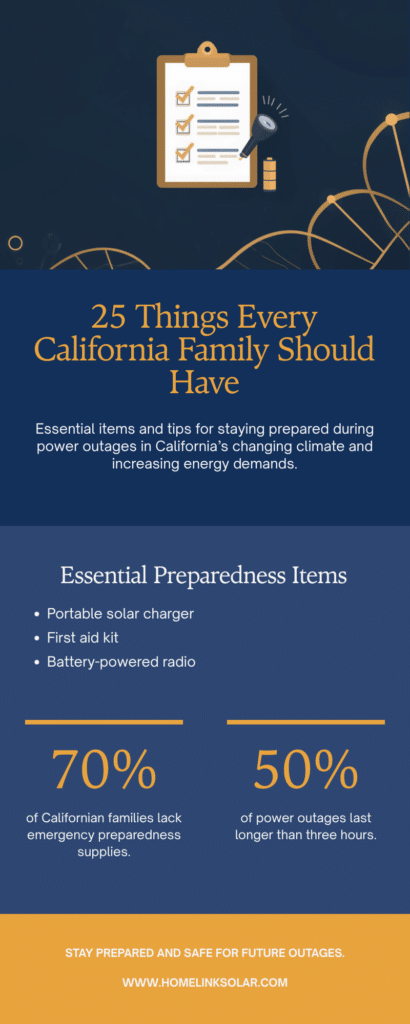
Whether the cause is a PSPS, an earthquake, or an ordinary storm, the supplies you actually need are largely the same. This checklist pulls together FEMA’s official Ready.gov guidance, USDA food safety recommendations, and CPUC backup power data, organized into six categories so you can check what you already have and fill the real gaps, not just buy another flashlight you don’t need. It also ties together our full preparedness library, linked throughout below.
Water and Food
- Water. One gallon per person per day, a minimum 3-day supply, for drinking and sanitation, per Ready.gov’s official kit guidance.
- A 3-day supply of non-perishable food. Canned goods, dried fruit, and shelf-stable meals that don’t require cooking.
- A manual can opener. Electric ones are useless without power, and this is one of the most commonly forgotten items on any list.
- A cooler with reusable ice packs. Bridges the gap once your refrigerator’s 4-hour safety window closes, covered in detail in What Happens to Refrigerators During Extended Outages?
- Paper plates, cups, and plastic utensils. Dishwashing with no hot water is its own hassle during an outage.
Light, Power, and Communication
- A flashlight for every family member. Not one central flashlight, one per bedroom, so nobody is navigating a dark house to find it.
- Extra batteries in multiple sizes. Check what your specific flashlights and radios actually take before you need them.
- A battery-powered or hand-crank NOAA weather radio. Cell networks can get congested during a widespread event; a dedicated radio doesn’t depend on them.
- Portable power banks, charged and ready. At least 20,000 mAh recommended, enough for multiple phone charges without a wall outlet.
- A backup power plan, portable or whole-home. Covered in full in Best Backup Power Options During Wildfires and How Long Can a Home Battery Power Your House?
- An appliance thermometer. Lets you know for certain whether your refrigerator or freezer is still holding a safe temperature instead of guessing.
Safety and Tools
- A first aid kit. Stocked and checked at least annually, not assembled once and forgotten.
- A whistle. To signal for help if you’re trapped or injured, standard Ready.gov guidance.
- Dust masks. Useful during structural cleanup and directly useful for wildfire smoke events.
- A wrench or pliers stored near your gas shutoff valve. Only use it if you smell gas or hear hissing, covered in How to Prepare Your Home for a Major California Earthquake.
- A fire extinguisher. Rated for your home’s specific risks and checked for charge annually.
Sanitation and Shelter
- Moist towelettes, garbage bags, and plastic ties. For personal sanitation when running water may be limited.
- Household bleach and a medicine dropper. For emergency water treatment (roughly 1/8 teaspoon per gallon, per Ready.gov), not for any other use.
- Plastic sheeting and duct tape. For sealing a room if shelter-in-place conditions require it.
- Emergency blankets and a complete change of warm clothing. Outages that hit during winter storms come with a temperature problem, not just a power problem.
Documents and Money
- Copies of important documents in a waterproof container. IDs, insurance policies, and medical information, both physical and on a password-protected drive.
- Cash in small bills. Card readers and ATMs often go down with the power grid.
- Local paper maps. GPS and cell service aren’t guaranteed during a widespread event.
Medical and Special Needs (2 Items)
- A 7-day supply of prescription medications, plus backup glasses, hearing aid batteries, or other specific medical needs.
- Supplies for infants, pets, or anyone with specific needs. Formula, diapers, pet food, and extra water sized for every member of the household, not just the adults.
What Are the Most Commonly Forgotten Items in a Power Outage Kit?
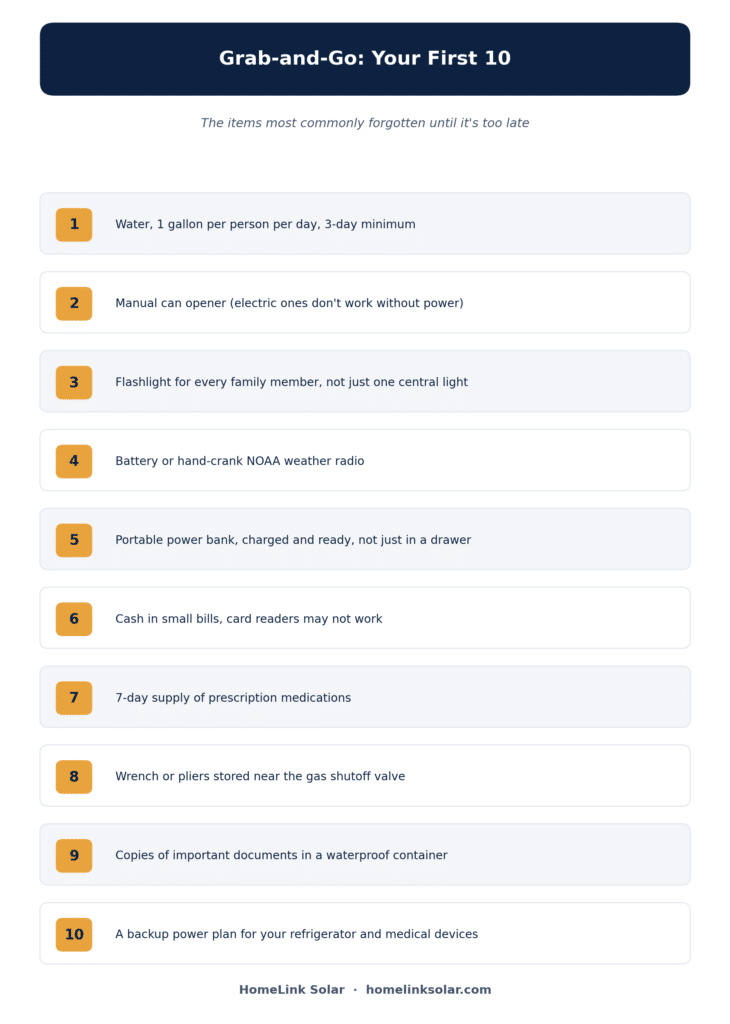
The manual can opener, a working appliance thermometer, and cash in small bills top the list, all three are easy to overlook precisely because they’re not dramatic. The gas shutoff wrench is a close fourth: most households know they should have one but haven’t actually confirmed where their shutoff valve is or whether the right size wrench is anywhere near it.
How Is a Power Outage Checklist Different From an Earthquake Kit?
They overlap heavily, but an earthquake kit needs a few things this general list doesn’t emphasize as strongly: sturdy shoes kept by every bed specifically for broken glass, a family communication plan for if you’re separated when it happens, and a larger water reserve since infrastructure damage, not just a downed line, can keep stores and tap water unavailable for longer. We cover the earthquake-specific additions in full in How to Prepare Your Home for a Major California Earthquake and what actually happens to your home’s systems afterward in What Happens if the Power Goes Out After an Earthquake? and Can Solar Panels Still Work After an Earthquake?
How Often Should an Emergency Kit Be Restocked?
At least once a year, ideally at a fixed point you won’t forget, like the start of Daylight Saving Time or the beginning of PSPS season each fall. Check expiration dates on food and medication, test that flashlights and radios still work, replace batteries even if they seem fine, and confirm your portable power bank still holds a charge. A kit that hasn’t been checked in three years is often worse than no kit at all, since it creates false confidence.
What Backup Power Items Belong on This List Beyond Flashlights and Batteries?
This is where most generic checklists stop short. A real backup power plan means knowing which specific circuits you want covered (refrigerator, medical equipment, Wi-Fi, at minimum), whether your solution recharges itself or is a fixed amount of stored energy, and how long a real PSPS event actually tends to last in your area, covered with real historical data in How Long Do PSPS Power Shutoffs Really Last in California? A portable power bank handles phone charging. It does not handle a refrigerator through a multi-day event, that’s a different category of planning entirely, covered in What Is a Public Safety Power Shutoff? and How to Prepare for California PSPS Power Shutoffs.
Does HomeLink Solar Offer a Downloadable Version of This Checklist?
Yes. HomeLink Solar (CSLB License #1117534) can provide a printable version of this checklist for your household, along with a personalized assessment of what backup power setup actually fits your home’s specific circuits and usage. Owner Mandy oversees every install personally, with no subcontractors. Explore real completed installs on our our installs page, no-large-upfront-cost options through our Power Choice Program, general solar and battery education on our Learn hub, or get a free personalized quote.
FAQs
What are the most commonly forgotten items in a power outage kit?
A manual can opener, a working appliance thermometer, cash in small bills, and a gas shutoff wrench stored where it’s actually accessible. None of these are dramatic, which is exactly why they get missed.
How is a power outage checklist different from an earthquake kit?
An earthquake kit adds sturdy shoes by every bed for broken glass, a family communication plan for separation, and a larger water reserve since infrastructure damage can extend how long stores and tap water stay unavailable.
How often should an emergency kit be restocked?
At least once a year. Check food and medication expiration dates, test flashlights and radios, replace batteries, and confirm power banks still hold a charge.
What backup power items belong on this list beyond flashlights and batteries?
A real plan for your critical circuits, refrigerator, medical equipment, and Wi-Fi at minimum, and a decision on whether that plan is a portable power bank (short-term, phone-level) or a home battery system (multi-day, whole-circuit).
Does HomeLink Solar offer a downloadable version of this checklist?
Yes, along with a personalized assessment of what backup power setup fits your household’s specific circuits, sized by our team rather than a generic package.
Related Reading
This checklist ties together our full preparedness library: How to Prepare Your Home for a Major California Earthquake, What Happens if the Power Goes Out After an Earthquake?, Can Solar Panels Still Work After an Earthquake?, How Long Can a Home Battery Power Your House?, What Is a Public Safety Power Shutoff?, How to Prepare for California PSPS Power Shutoffs, How Long Do PSPS Power Shutoffs Really Last in California?, Best Backup Power Options During Wildfires, and What Happens to Refrigerators During Extended Outages?
Sources
- Ready.gov / FEMA — Build a Kit
- Ready.gov / FEMA — Low and No Cost Preparedness
- USDA / FoodSafety.gov — Food Safety During Power Outage (see our refrigerator-specific guide for full citations)