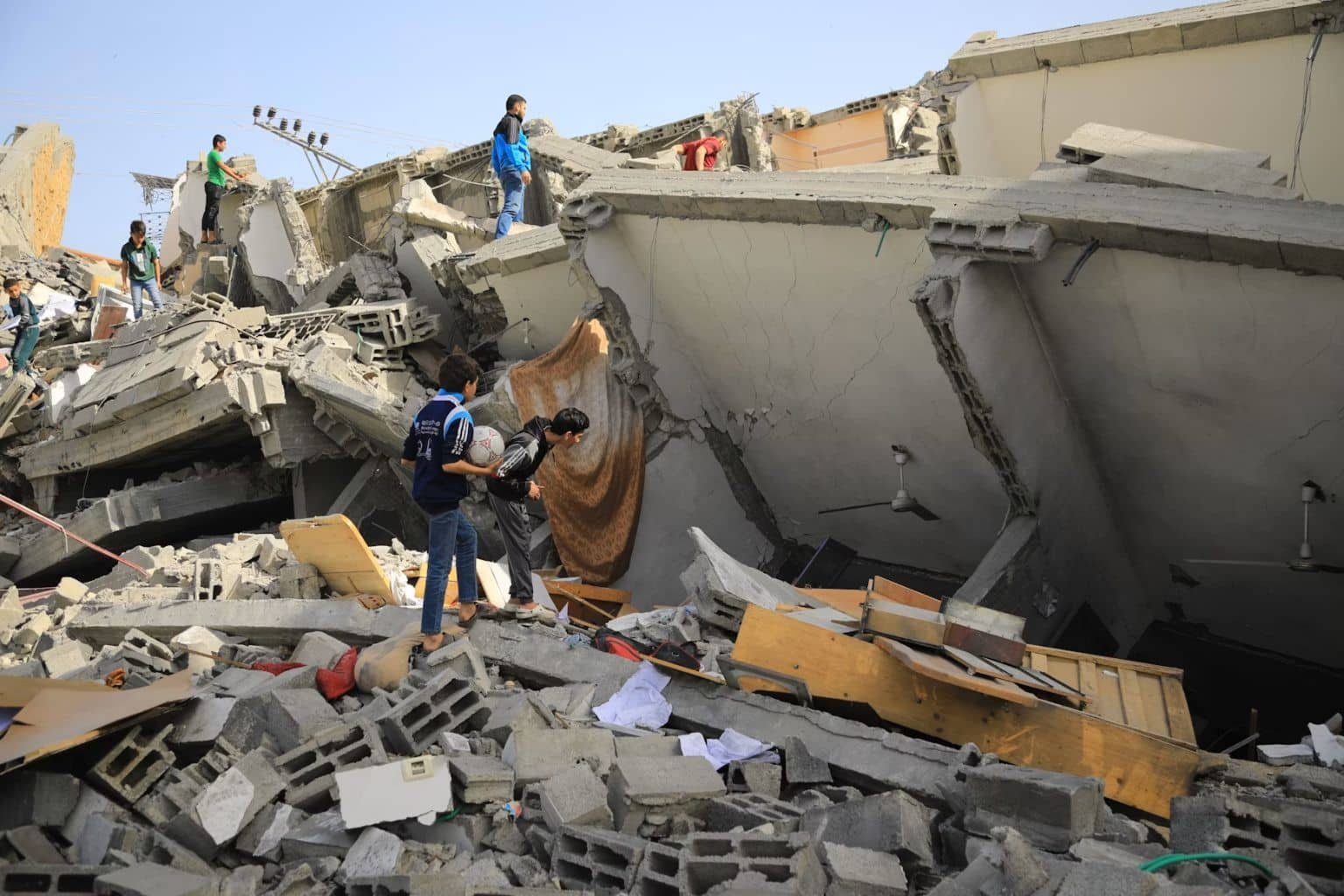
The shaking stops, and the next few minutes matter almost as much as the earthquake itself. What you do right after, not just what you prepared beforehand, determines how safely you get through the rest of that day. This guide walks through exactly that: the first two minutes, the first hour, and the first 24 hours, in order, based on official guidance from the Earthquake Country Alliance, USGS, and FEMA.
This is the fifth piece in our earthquake and outage preparedness series. If you haven’t read the others, see How to Prepare Your Home for a Major California Earthquake, What Happens if the Power Goes Out After an Earthquake?, Can Solar Panels Still Work After an Earthquake?, and How Long Can a Home Battery Power Your House?
What Are the First Steps to Take Right After a Major Earthquake?
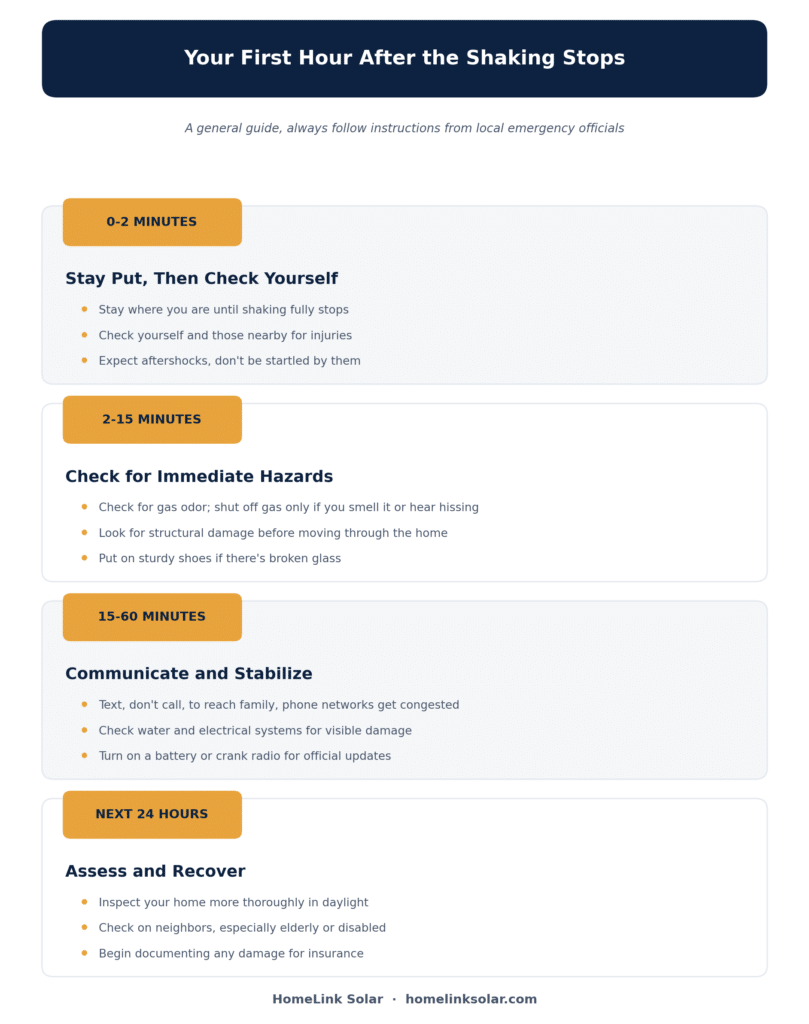
The Earthquake Country Alliance’s Seven Steps to Earthquake Safety, developed with the Southern California Earthquake Center and USGS, frames the immediate aftermath as Step 6: improve safety by evacuating if necessary, helping the injured, and preventing further injuries or damage. In practical order:
- Stay where you are until shaking fully stops. Most injuries happen when people try to move during the shaking, not from the shaking itself.
- Check yourself and the people near you for injuries before checking anything else.
- Expect aftershocks. They can arrive seconds or hours later, and shouldn’t be mistaken for a new, separate event requiring different action.
- Check for gas odor. If you smell gas or hear hissing, shut off the gas at the meter and leave the area. If you don’t smell gas, leave the shutoff valve alone, unnecessarily shutting it off can delay your utility’s ability to restore service.
- Look for structural damage before moving freely through your home, cracked walls, doors that won’t close properly, or visible foundation shifts are signs to exit and call a professional before re-entering.
- Put on sturdy shoes. Broken glass on the floor is one of the most common sources of post-earthquake injury, and it’s often invisible in low light.
Communicate Without Overloading the Network
According to FEMA’s official disaster communication guidance, text messages are more likely to get through than phone calls after a major disaster, since phone systems are often overloaded or damaged and voice calls consume far more network capacity than texts. Send a short text to let people know you’re safe, then use social media or a messaging app if calls aren’t going through. Save voice calls for genuine emergencies, so the network stays available for first responders.
How Long Should My Family Be Prepared to Be Without Power?
Longer than you’d expect from a single event. The 1994 Northridge earthquake knocked out power to more than 825,000 Southern California Edison customers, and while crews restored most service within a day, some neighborhoods near damaged infrastructure waited considerably longer. Aftershocks can also trigger repeat outages over days or weeks rather than one clean event. We break down exactly why grid outages last as long as they do, with real historical numbers, in What Happens if the Power Goes Out After an Earthquake? As a baseline, plan for at least 72 hours without power, and treat anything shorter as a pleasant surprise rather than the expectation.
Earthquake Emergency Kit vs. Backup Power: What’s the Difference?
These solve different problems, and confusing them leaves gaps in both. An earthquake survival kit (sometimes called an earthquake emergency kit) covers your physical needs when infrastructure is down: water, non-perishable food, a first aid kit, flashlights, a manual can opener, sturdy shoes, and copies of important documents. It doesn’t generate or store electricity. Backup power, a battery or solar-plus-battery system, keeps specific circuits running: your refrigerator, medical equipment, Wi-Fi, and phone charging. A full emergency kit with no backup power still leaves your food spoiling and your phone dead. Backup power with no emergency kit still leaves you without water or first aid supplies if the outage extends past what your pantry can cover. You need both, and they don’t substitute for each other. Our full earthquake preparedness guide covers exactly what belongs in the kit itself, while How Long Can a Home Battery Power Your House? covers the backup power side in detail.
Should I Check My Home’s Electrical System Before Restoring Power?
Yes. Don’t assume that because the grid is back on, your home’s systems are safe to simply switch back on without a look. Check your breaker panel for tripped breakers or visible damage, look at your solar inverter’s status display if you have one, and confirm nothing was loosened or shifted during the shaking before assuming everything is fine. We cover the specific inspection checklist for solar and battery systems in Can Solar Panels Still Work After an Earthquake? If anything looks abnormal, or you’re not sure, use the CSLB’s public license lookup to confirm you’re working with a properly licensed electrician or solar contractor before anyone touches the system.
Understanding the Risk: The San Andreas Fault and California’s Earthquake Reality
Much of California’s earthquake risk traces back to a single, well-studied feature. The San Andreas Fault runs roughly 800 miles through California, marking the boundary where the Pacific Plate and North American Plate grind past each other. According to USGS research on the fault’s earthquake history, the southern San Andreas has produced a major rupture roughly every 150 years going back over a millennium, and its last major rupture was in 1857. That gap is part of why the southern segment is considered a likely location for a significant earthquake within coming decades, alongside the statewide figure we’ve cited throughout this series: more than a 99 percent chance of a magnitude 6.7 or larger earthquake somewhere in California within the next 30 years, according to USGS’s UCERF3 forecast. This isn’t a prediction of when, scientists can’t offer that, it’s the reason “immediately after” guidance like this exists at all.
When to Evacuate vs. Shelter in Place
Stay in or near your home if it appears structurally sound, utilities are stable or safely shut off, and you have adequate supplies. Evacuate if you see structural damage like leaning walls or a shifted foundation, if you smell gas that doesn’t stop after shutting off the meter, if local officials issue an evacuation order, or if a tsunami warning applies to your coastal area. When in doubt, leave and let a professional assess the structure before you return.
Documenting Damage for Insurance
Once it’s safe, photograph and video every room, focusing on cracks, shifted items, and anything broken, before you clean up or make repairs. Keep receipts for any emergency repairs or temporary lodging. Contact your insurance provider as soon as reasonably possible, and ask specifically whether your policy includes earthquake coverage, since standard homeowners insurance in California typically does not include it by default.
Can HomeLink Solar Help My Home Recover Power Faster After a Quake?
Yes. HomeLink Solar (CSLB License #1117534) inspects existing solar and battery systems, including ones we didn’t originally install, following a major seismic event, and can help you get a damaged or disconnected system back online safely. Owner Mandy oversees every inspection and service call personally, with no subcontractors. If your home doesn’t have battery backup yet and you want to reduce how long the next earthquake actually keeps you in the dark, our team can walk through sizing options built around your specific home, not a generic package.
FAQs
What are the first steps to take right after a major earthquake?
Stay where you are until shaking fully stops, check yourself and others for injuries, check for gas odor before touching any shutoff valve, look for structural damage before moving freely through your home, and put on sturdy shoes because of broken glass. Expect aftershocks and don’t mistake them for a separate event.
How long should my family be prepared to be without power?
Plan for at least 72 hours as a baseline. Major California earthquakes have knocked out power to hundreds of thousands of customers at once, and while many outages resolve within a day, hard-hit areas and aftershock-driven repeat outages can extend it well past that.
What’s the difference between an earthquake emergency kit and backup power?
An emergency kit covers physical needs like water, food, and first aid when infrastructure is down, it doesn’t generate electricity. Backup power, a battery or solar-plus-battery system, keeps specific circuits running, like your refrigerator and communication devices. You need both; neither substitutes for the other.
Should I check my home’s electrical system before restoring power?
Yes. Check your breaker panel, inverter status, and any visible wiring or mounting hardware before assuming everything is fine just because the grid is back on. If anything looks abnormal, have a licensed electrician or solar contractor look at it before continuing.
Can HomeLink Solar help my home recover power faster after a quake?
Yes. HomeLink Solar inspects and services existing solar and battery systems after a major earthquake, including systems we didn’t originally install, and can help homeowners considering backup power for the first time size a system for their specific home.
Related Reading
This piece is part of our earthquake and outage preparedness series. See How to Prepare Your Home for a Major California Earthquake, What Happens if the Power Goes Out After an Earthquake?, Can Solar Panels Still Work After an Earthquake?, and How Long Can a Home Battery Power Your House? for the rest of the cluster.
Sources
- Earthquake Country Alliance / USGS — Seven Steps to Earthquake Safety
- FEMA — Best way to communicate after a disaster
- USGS — Back to the Future on the San Andreas Fault
- USGS / Earthquake Country Alliance — California earthquake probability (UCERF3)
- CSLB — Public license lookup