Why a Dirty Panel Looks Exactly Like a Fine One
If your electricity bill crept up last month, solar panel cleaning may be the fastest way to recover lost production. The system looks fine from the driveway. The inverter is running. There’s been no shade from new tree growth. What you’re actually looking at is a layer of Central Valley dust, spring pollen, or coastal salt film sitting between your solar cells and the sun.
At HomeLink Solar, our installation crews see this pattern constantly across California properties, from Fresno to coastal San Diego. The panels aren’t broken. They’re just dirty. Yet many homeowners either skip cleaning entirely or reach for the wrong tools and solutions. This guide walks through exactly when to clean, how to do it safely yourself, what the research actually says about how much you’ll get back, and when calling a professional crew makes more financial sense than doing it yourself.
Why California’s Climate Hits Solar Panels Harder Than Most States
California’s geography creates one of the more demanding soiling environments for photovoltaic systems in the country, and the cause varies by region:
- Inland and Central Valley regions deal with year-round dust and heavy spring pollen loads.
- Agricultural zones around Fresno, Bakersfield, and Salinas add fertilizer dust and crop residue on top of ordinary soiling.
- Coastal homeowners from San Diego up through the Bay Area face salt-film buildup that doesn’t rinse away as easily as loose dust.
- Wildfire smoke leaves a fine, sticky ash layer that a single rainstorm doesn’t fully clear.
- Highway-adjacent homes can pick up an oily film from vehicle exhaust that accumulates gradually.
Each of these contaminants blocks a portion of sunlight from reaching the solar cells, and the loss compounds the longer it sits. The clearest evidence on just how much comes from a 2013 UC San Diego study that tracked 186 residential and commercial solar sites across California through the rain-free stretch of the 2010 drought. Researchers Felipe Mejia and Jan Kleissl found that panels lost roughly 0.05% of output per day without rain or cleaning, adding up to a 7.4% efficiency loss after 145 consecutive rain-free days (UC San Diego Jacobs School of Engineering; published in Solar Energy, 2013).
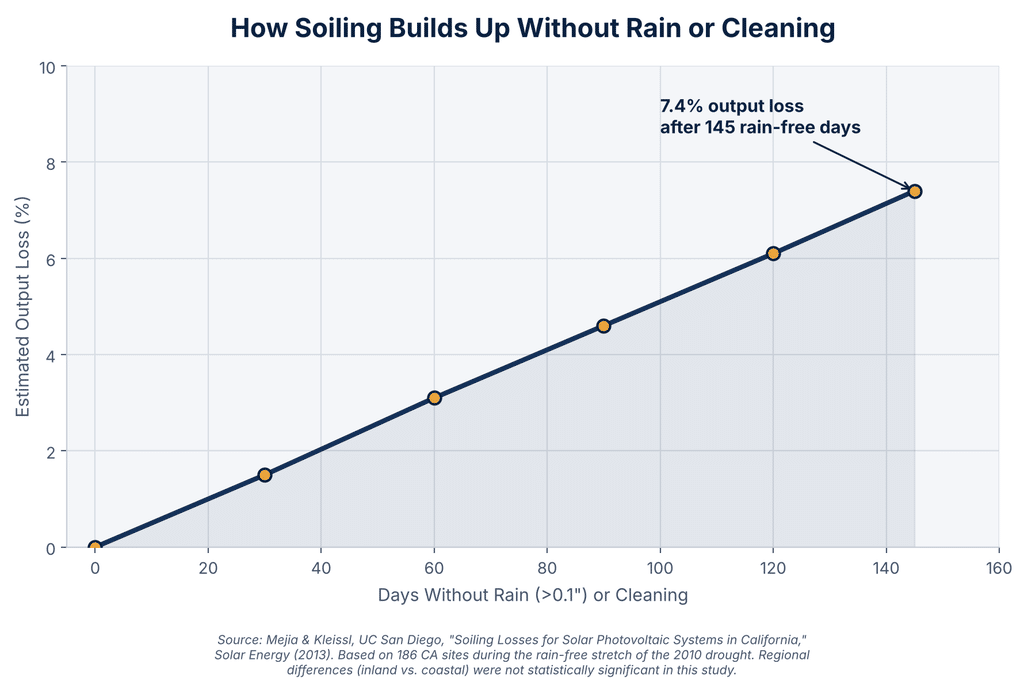
One nuance worth knowing: that UC San Diego study found regional differences between inland and coastal sites were not statistically significant during the drought period it measured, and it treated any rainfall over 0.1 inches as effectively resetting the panels. That matters for how you think about your own cleaning schedule, which we’ll get to in the “how often” section below. It also means a widely repeated claim that specific regions lose a fixed percentage of output annually to soiling isn’t something the underlying research actually supports, so we’re not going to repeat it here. What the research does support clearly is that soiling accumulates steadily without rain, and that bigger systems or heavier contamination (ash, bird droppings, agricultural residue) change the math.
How to Tell Your Panels Actually Need Cleaning
Pull up your monitoring app or inverter dashboard and look for a persistent drop of 5 to 10% below your system’s normal weather-adjusted baseline. The key word is persistent. A soiling-related dip is gradual and steady, not a sudden cliff.
Before blaming dirt, rule out the obvious:
- Partial shading from a new branch or structure
- A seasonal sun-angle shift affecting a fixed-tilt array
- An inverter fault or firmware issue
If none of those apply and the dip has held steady over several weeks, soiling is the likely culprit. Visual inspection from the ground also tells you a lot:
- A yellowish or grey haze across the panel surface (dust)
- A green-tinged film after spring storms (pollen)
- A white mineral crust near panel edges (hard-water sprinkler overspray)
- Visible bird droppings on one or more panels
A single bird dropping on one panel can meaningfully reduce that panel’s string output. That’s a sign to act on right away, not something to add to a future cleaning schedule, since droppings that bake onto glass for weeks can cause staining that no amount of later cleaning reverses.
Solar Panel Cleaning: DIY Steps, Tools, and Solutions
The right kit doesn’t require specialty equipment:
- A soft microfiber mop or cloth
- A soft nylon brush with flexible bristles (never stiff bristles)
- A rubber-blade squeegee
- A garden hose with a gentle spray nozzle
- Distilled or deionized water for the final rinse (prevents mineral spotting)
Tap water works fine for the initial flush in most inland areas, but coastal and hard-water regions should finish with purified water to avoid leaving new mineral spots behind.
For cleaning solution, 2 to 4 drops of mild dish soap in a gallon of water handles most routine soiling. White vinegar diluted 1:1 with water works on mineral deposits and hard-water scale. Avoid ammonia-based glass cleaners, bleach, solvents, and any abrasive powders entirely. Most manufacturers also discourage pressure washers, since high-pressure jets aimed at seals and junction boxes can cause real damage. Always check your specific module’s manual before cleaning, since some manufacturers (including modules with certain anti-reflective coatings) restrict wet-contact cleaning methods altogether and recommend dry methods instead. Using a prohibited cleaning product or method can void your panel warranty, which is not a trade-off worth making for a routine cleaning task. If you installed through HomeLink Solar and aren’t sure what your module allows, our service team can confirm it for you.
Step-by-Step Cleaning Sequence
- Wait until the panels are cool. Early morning or late afternoon is ideal, since cold water on hot glass causes thermal stress.
- Rinse the surface with a gentle hose spray to flush loose grit before any physical contact.
- Apply diluted dish soap with a soft microfiber mop or sponge using light, even strokes.
- Rinse thoroughly from top to bottom so soapy water drains off completely.
- Follow with a distilled-water rinse if mineral spotting is a concern in your area.
- Squeegee from top to bottom to prevent water spots as the surface dries.
What Cleaning Actually Recovers
How much output you get back depends on what caused the loss in the first place:
- Loose dust and soil are the most recoverable. A proper cleaning typically restores the large majority of lost output, consistent with the gradual, steady accumulation pattern the UC San Diego research documented.
- Pollen buildup responds well to thorough wet cleaning, since it tends to sit on the surface rather than bond to the glass.
- Bird droppings are a near-total recovery if removed promptly with softened water and a microfiber cloth. The risk isn’t the droppings themselves; it’s using harsh scrapers or chemicals to remove them, which can scratch the glass or void a warranty.
Rain alone is not always enough. The UC San Diego researchers treated rainfall over 0.1 inches as roughly equivalent to a cleaning for loose dust, which is good news for inland homeowners after a real storm. But rain is far less effective against salt film, oily highway residue, and baked-on agricultural dust, none of which rinse away the way loose dirt does. Many California homeowners assume a rainy December resets their panels completely; for coastal salt film in particular, that assumption often doesn’t hold, and monitoring data is the only way to know for sure.
Solar Panel Cleaning Costs in California: DIY vs. Professional
When DIY Cleaning Isn’t the Right Call
Roof pitch is the primary safety threshold. Steeper roofs commonly require professional fall protection and aren’t recommended for DIY cleaning. Multi-story homes compound that risk further. If your system sits on a steep roof or a second story, the financial case for professional service is straightforward: a cleaning visit costs a fraction of what an emergency room visit or a voided warranty dispute would.
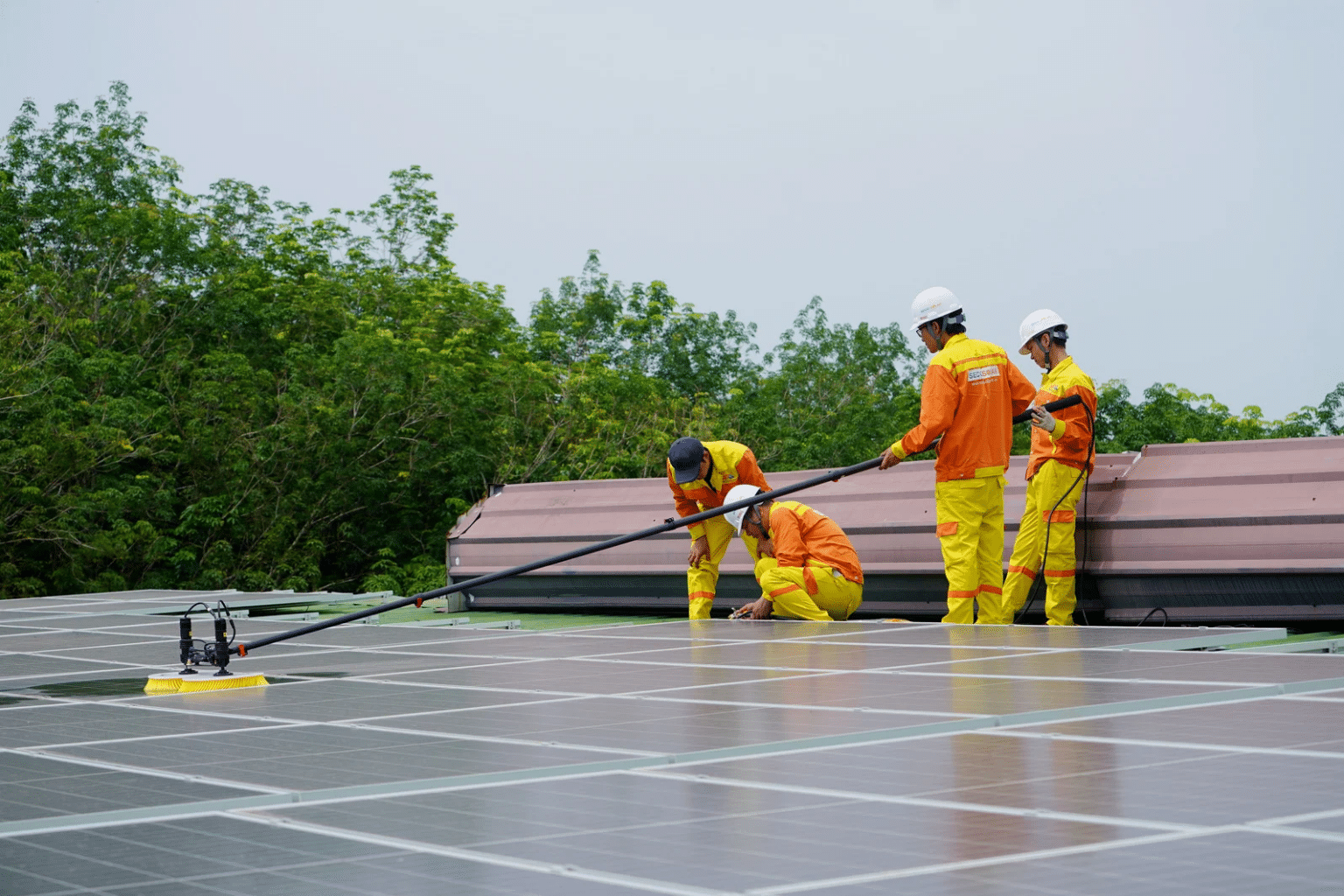
Heavy mineral crust, post-wildfire ash requiring chemical treatment, and modules with manufacturer-mandated pH-neutral solutions are also situations where professional equipment makes a real difference. HomeLink Solar’s cleaning crews use soft water-fed brush systems and pH-neutral solutions, followed by a post-clean production check that confirms the improvement is real, not assumed. Every visit is handled by our own trained crew rather than a rotating subcontractor, which is the same in-house accountability model we use for installations. Bundling a cleaning with an annual inspection reduces scheduling friction and typically lowers the overall cost. If you’re still comparing installers and want to understand why crew structure matters for service quality down the road, our guide on how to choose a solar installer and our breakdown of subcontractor risk cover that in more depth.
What Professional Solar Cleaners Charge
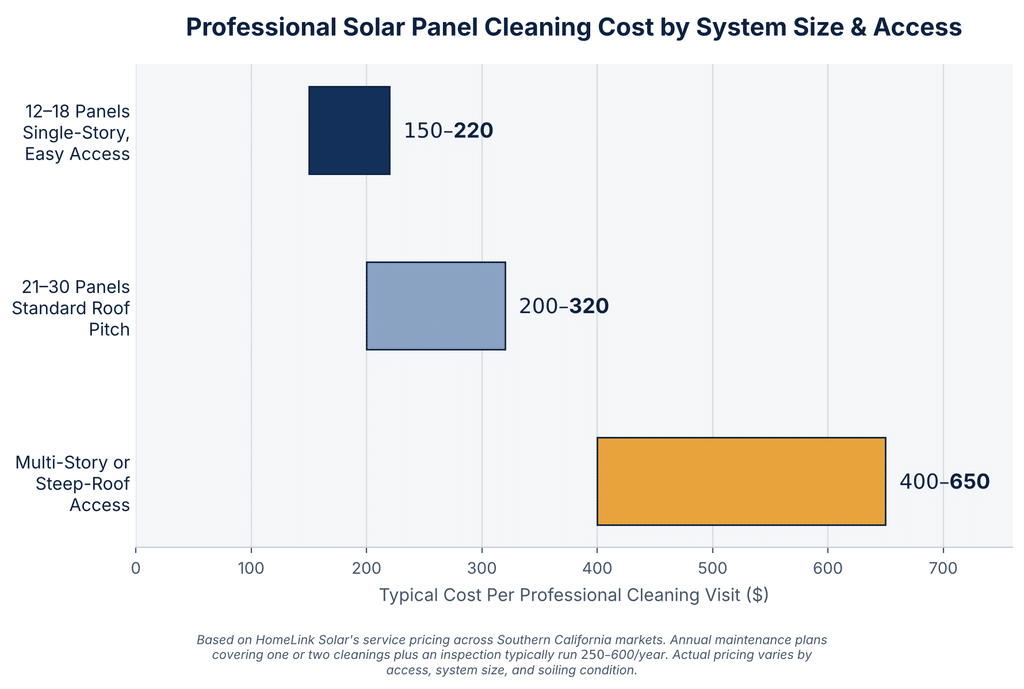
Pricing scales with system size and roof access:
- 12 to 18 panels, single-story, easy access: approximately $150 to $220 per visit
- 21 to 30 panels, standard roof pitch: approximately $200 to $320 per visit
- Multi-story or steep-roof access: approximately $400 to $650 per visit
- Annual maintenance plans (one or two cleanings plus an inspection): typically $250 to $600 per year
Across major Southern California markets, Los Angeles cleaning typically runs $150 to $320 per visit, San Diego runs $140 to $300, and Sacramento falls in the $150 to $300 range. Bundling recurring service into an annual plan usually brings the per-visit rate down.
How Often to Clean, by California Region
Frequency should ultimately be driven by your own monitoring data rather than a fixed calendar, but these regional baselines are a solid starting point:
- Coastal areas (San Diego, Los Angeles, the Bay Area): every 3 to 4 months. Salt film accumulates even on calm days and doesn’t respond to rain the way loose dust does.
- Inland and Central Valley homes: every 1 to 3 months during the dry season, when dust and agricultural residue build up fastest.
- Agricultural zones (Fresno, Bakersfield, Salinas): roughly 3 to 4 times per year, timed after major pollen seasons and post-harvest.
- Northern California and foothill areas with meaningful rainfall: often just one or two cleanings a year, with a spring check as the baseline.
Regardless of region, some events override the calendar entirely:
- Visible wildfire ash: clean within 48 to 72 hours if conditions are safe. Ash is abrasive and can affect surface coatings with prolonged contact.
- A dust storm that visibly coated the array
- A sudden, unexplained production drop of 10% or more
- Concentrated bird droppings on any section of the system
Waiting for the next scheduled cleaning when one of these events has already happened means accepting weeks of compounding efficiency loss for no good reason.
Keeping Your System Performing the Way It Was Designed To
Solar panel cleaning is a high-ROI maintenance task that most California homeowners underestimate, and the UC San Diego research is a useful reality check in both directions: soiling losses are real and they compound steadily, but for a typical small residential system, the researchers found that washing mid-drought often wasn’t worth the cost on its own, with bird droppings and larger systems being the clear exceptions. The practical takeaway is to let your monitoring data drive the decision rather than a generic rule, and to treat regional guidelines as a starting point.
If your system’s production doesn’t match what you’d expect given your panel count, understanding how your output is actually measured helps too. Our kilowatt-to-megawatt conversion guide walks through the math behind your system’s rated output if you want to double-check your monitoring numbers against the math yourself. And if persistent underperformance has you reconsidering your system’s value altogether, our breakdown of solar installation costs, pros, and cons and our piece on why California electric bills keep climbing both provide useful context for what you’re protecting by keeping your system clean.
Frequently Asked Questions
How often should I clean my solar panels in California?
It depends on your region and what your monitoring data shows. Coastal homes typically need cleaning every 3 to 4 months due to salt film, inland and Central Valley homes every 1 to 3 months during the dry season, and Northern California or foothill homes with regular rainfall often just once or twice a year. A persistent 5 to 10% output drop below your weather-adjusted baseline is the real signal to act on, regardless of calendar timing.
Can I clean my own solar panels, or do I need a professional?
Single-story homes with easy, safe roof access and routine dust or pollen buildup are reasonable candidates for DIY cleaning using a soft brush, mild soap, and a garden hose. Steep roofs, multi-story access, heavy mineral crust, post-wildfire ash, or modules with manufacturer-specific cleaning restrictions are all situations where professional equipment and training make more sense, both for safety and for warranty compliance.
Does rain clean solar panels, or do I still need to wash them?
Rain helps with loose dust, and research from UC San Diego treated rainfall over 0.1 inches as roughly equivalent to a cleaning for that type of soiling. But rain is much less effective against coastal salt film, oily residue near highways, and baked-on agricultural dust or wildfire ash, which typically need an actual wash to remove.
How much output can dirty solar panels actually lose?
Based on UC San Diego research tracking 186 California sites through a rain-free drought stretch in 2010, panels lost roughly 0.05% of output per day without rain or cleaning, adding up to a 7.4% loss after 145 consecutive dry days. Losses from heavier contamination like wildfire ash, agricultural residue, or bird droppings can be more severe and more immediate than that baseline dust-accumulation rate.
Does HomeLink Solar offer professional solar panel cleaning in California?
Yes. HomeLink Solar’s in-house cleaning crews use soft water-fed brush systems and pH-neutral solutions, followed by a post-clean production check that confirms the output improvement is real. Every visit is handled by our own trained crew rather than a subcontractor, and cleanings can be bundled with an annual inspection to reduce scheduling friction and overall cost. You can request a service visit or reach out through our quote page for a free production review.
Related Reading
- Does HomeLink Solar Use In-House Crews?
- How to Choose a Solar Installer: Avoid Subcontractor Risks
- Solar Subcontractor Risk: 3 Steps to Protect Your Home
- Kilowatt to Megawatt Conversion Explained
- Solar Panel Installation Cost, Pros and Cons
- Why Is My California Electric Bill So High?
- Why Waiting Another Year Could Cost Homeowners Thousands
HomeLink Solar Service & Program Pages
Sources
- Mejia, F. & Kleissl, J., “Soiling Losses for Solar Photovoltaic Systems in California,” Solar Energy, 2013 — via UC San Diego Jacobs School of Engineering press release
- Full study text via UC eScholarship