“Solar will still be there next year” is true. What it costs to get it won’t be the same. Three real, documented trends are converging right now, not marketing pressure, actual policy and market changes, and together they make waiting a genuinely expensive decision rather than a neutral one. Here’s the real math, not a sales estimate.
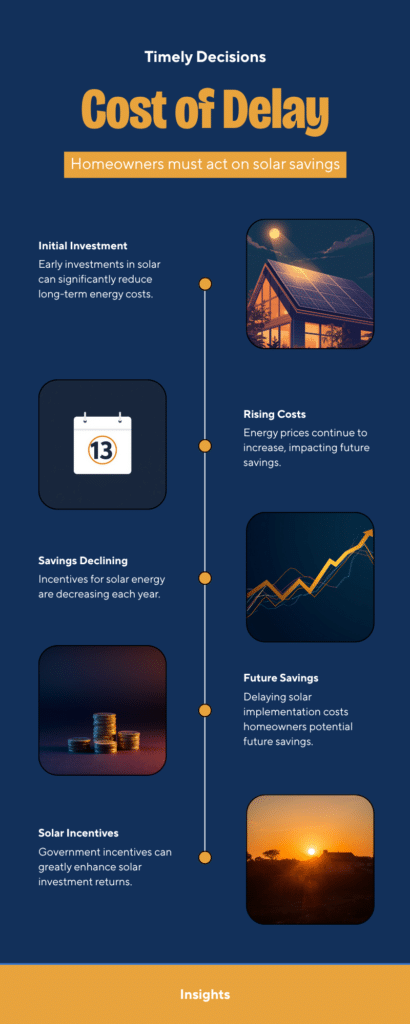
How Much Does Delaying a Solar Installation Actually Cost Over Time?
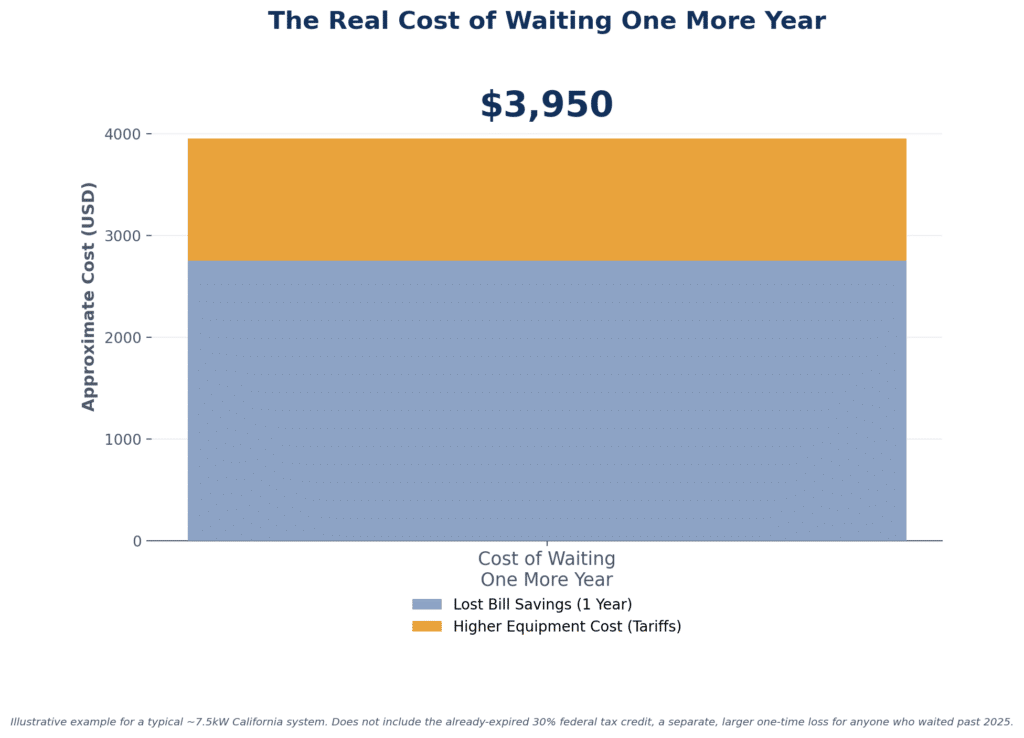
Two components stack on top of each other for every year you wait: the electricity bill savings you don’t capture, and the higher equipment cost you’ll likely pay when you do install. For a typical California system, a year of delay means roughly $2,750 in bill savings never captured (offset electricity you kept buying from the utility instead), plus a system that costs more to install than it would have, driven by new 2026 tariffs covered below. That’s before factoring in whatever SCE or SDG&E’s next approved rate increase turns out to be.
How to Calculate Your Own Cost of Waiting, Step by Step
- Find your current monthly electricity bill. Check a recent statement, or your account online, for your average monthly cost.
- Estimate your likely offset percentage. Most well-sized residential systems offset somewhere between 70% and 100% of usage; ask an installer for a number specific to your roof and usage.
- Multiply to get annual avoided cost. Monthly bill × offset percentage × 12 months gives a reasonable estimate of what a system would save you in the first year.
- Add expected rate increases. SCE alone has approved increases of 17% (2022), 7.2% (2024), and 10% (2025), see How Much Have SCE Rates Increased? for the full history. Every year you wait, that avoided-cost number gets larger, not smaller.
- Add the equipment cost delta. Ask a prospective installer whether current tariff-driven pricing is expected to hold, rise, or fall over your likely decision window.
- Sum it up. Lost year-one savings plus the likely equipment cost increase is a reasonable floor for what waiting one more year actually costs you.
Do Incentives or Rebates Change Year to Year?
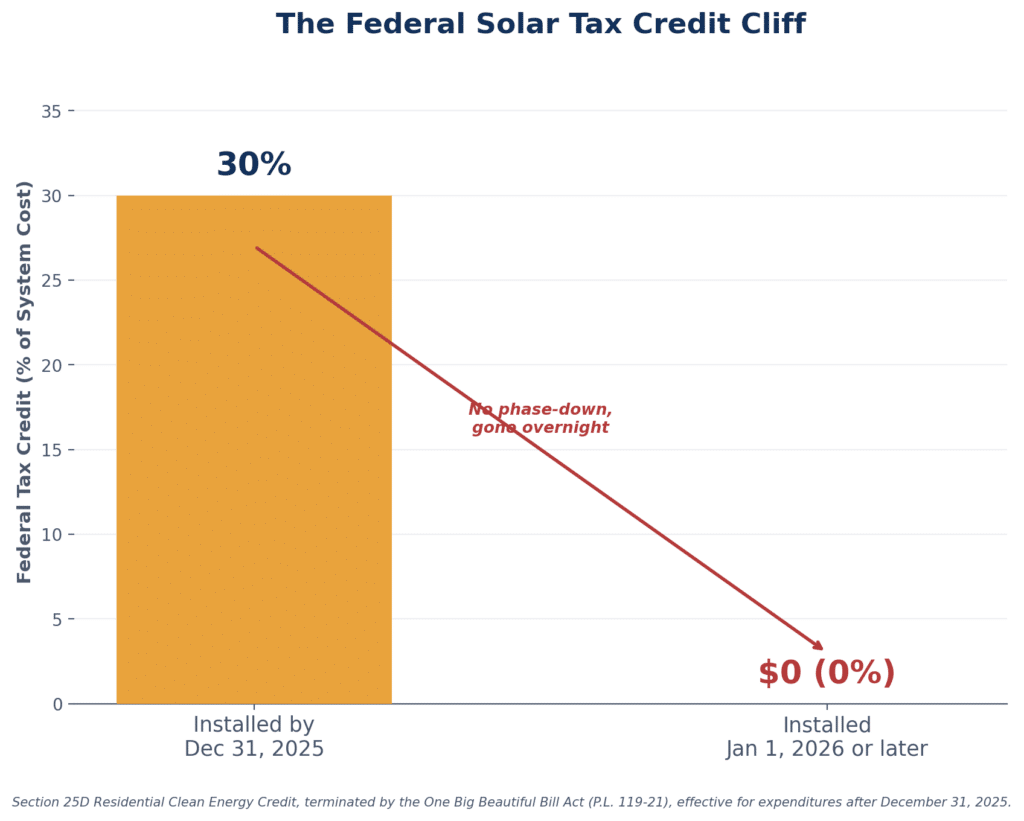
Yes, and the clearest example just happened. The 30% federal Residential Clean Energy Credit (Section 25D) applied to solar systems placed in service through December 31, 2025. The One Big Beautiful Bill Act, signed July 4, 2025, terminated it with no phase-down and no transition period, confirmed directly on the IRS’s own Residential Clean Energy Credit page. Anyone who installed by the deadline still gets the full 30% credit on their 2025 return. Anyone installing in 2026 or later gets $0 from the federal government for a homeowner-owned system, there’s no smaller credit to fall back on, it’s simply gone. This is exactly the kind of change that makes “I’ll do it next year” a genuinely costly sentence, incentives are not guaranteed to still exist next year, and this one already didn’t.
How Does Compounding Rate Increases Affect the True Cost of Waiting?
It compounds in your utility’s favor, not yours. Every SCE rate increase applies to your entire bill, indefinitely, until you offset some of that usage with your own generation. Using SCE’s own recent pattern, roughly 7% to 17% in a single approved step, a household that waits three years before installing isn’t just missing three years of today’s savings rate, they’re missing three years of savings calculated against a rate that itself kept climbing each of those years. The math works against procrastination in both directions at once: the thing you’re not offsetting gets more expensive, and the offset you’d be getting gets permanently pushed later. We break down exactly why California rates specifically keep climbing, wildfire mitigation spending and the NEM 3.0 cost-shift chief among them, in Why California Electric Rates Keep Increasing.
Is It Cheaper to Install Solar Now or Wait for Prices to Drop?
Based on current, dated policy, waiting for a price drop is a weak bet right now. New Section 232 tariffs take effect December 4, 2026, establishing minimum import prices of 38 cents per watt for solar modules and 22 cents per watt for cells, plus a 15% duty on polysilicon derivatives, raising typical installed system costs by an estimated 3% to 5%. This reverses a genuinely unusual, decade-long pattern: solar installation costs fell by roughly 50% since 2010 as the industry scaled, but Solar.com’s own 2026 pricing analysis notes prices “ticked upward slightly in 2025 due to tariffs,” and that current conditions might represent “the lowest price environment for solar for several years.” Betting on a future price drop now means betting against the direction tariff policy is actually moving.
Can HomeLink Solar Show Me a Personalized Cost-of-Waiting Estimate?
Yes. HomeLink Solar (CSLB License #1117534) will run the real numbers for your specific home, your actual usage, SCE or SDG&E’s current rate, and a system sized to your roof, rather than the generic example above. Owner Mandy oversees every install personally, with no subcontractors. See real completed installs on our our installs page, explore no-large-upfront-cost options through our Power Choice Program, compare us directly to a national provider in HomeLink vs. Sunrun, or get a free personalized quote.
FAQs
How much does delaying a solar installation actually cost over time?
For a typical California household, roughly $2,750 in unrealized first-year bill savings plus a likely 3% to 5% higher equipment cost due to 2026 tariffs, before accounting for whatever the next utility rate increase turns out to be.
Do incentives or rebates change year to year?
Yes. The clearest recent example: the 30% federal Residential Clean Energy Credit expired December 31, 2025, with no phase-down, confirmed on the IRS’s own site. Systems installed in 2026 or later receive $0 from that credit.
How does compounding rate increases affect the true cost of waiting?
Each year you wait, you’re paying an ever-higher utility rate on usage you could have offset, and you’re pushing your eventual savings further into the future. SCE alone has approved increases of 17%, 7.2%, and 10% in recent steps.
Is it cheaper to install solar now or wait for prices to drop?
Not based on current policy. New federal tariffs effective December 4, 2026 are raising typical installed costs an estimated 3% to 5%, reversing the decade-long price decline the industry previously saw.
Can HomeLink Solar show me a personalized cost-of-waiting estimate?
Yes, using your actual usage, your utility’s current rate, and a system sized to your specific home, with owner Mandy personally overseeing every install.
Related Reading
See How Much Have SCE Rates Increased?, Why California Electric Rates Keep Increasing, Why Backup Power Is Becoming Essential in California, and HomeLink vs. Sunrun.
Sources
- Congress.gov / CRS — Expiration and Carryforward Rules for the Residential Clean Energy Credit
- IRS — Residential Clean Energy Credit
- SolarReviews — US Solar Panel Costs to Rise with New Tariffs in 2026
- Solar.com — Solar Panel Cost in 2026: Full Pricing Guide