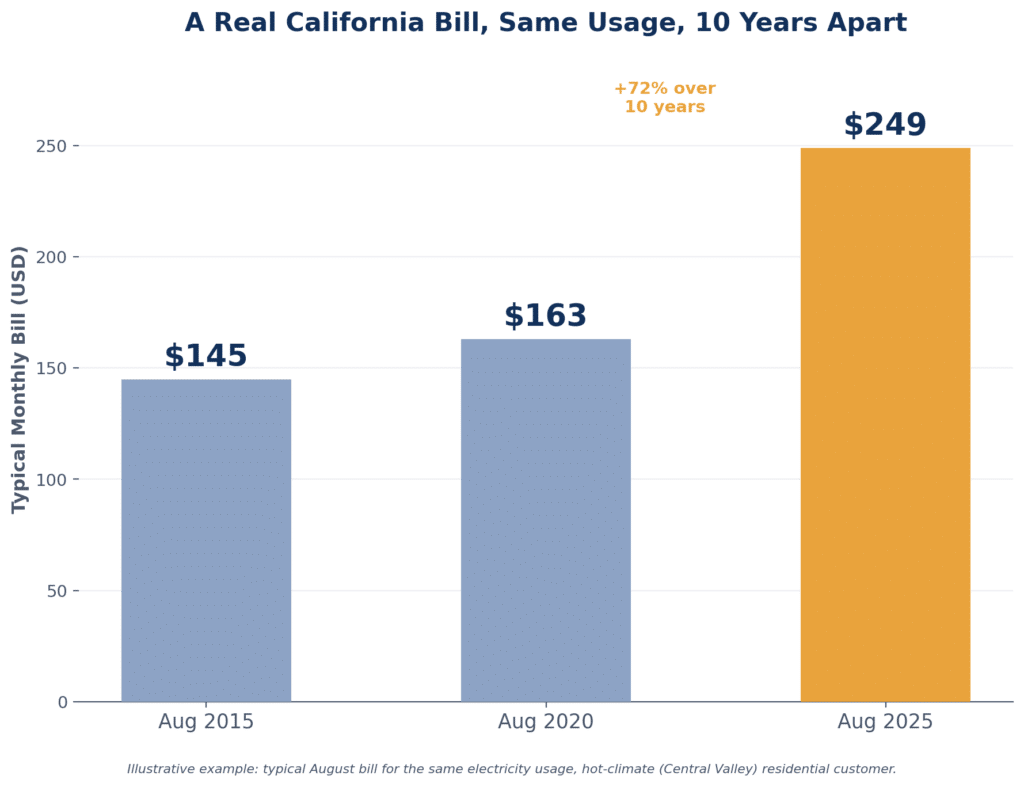
A typical hot-climate California household paid about $145 for its August electricity bill in 2015. By 2025, the same usage cost about $249, a 72% increase in a decade, well ahead of inflation. This isn’t a single price spike, it’s a decade-long structural shift in what California households actually pay for when the power bill arrives. Here’s what’s actually driving it, sourced from UC Berkeley research, CPUC’s own reporting, and independent journalism, not just “rates are high.”
Why Are California Electric Rates Among the Highest in the Country?
California has the second-highest electricity prices in the nation, behind only Hawaii, and according to UC Berkeley’s Haas Energy Institute, the gap didn’t happen gradually, it accelerated sharply after 2018. As Berkeley Haas director Severin Borenstein put it, distribution costs are the two biggest drivers, “most of which is increased costs of dealing with wildfires, dealing with past wildfires, dealing with current risks and trying to mitigate future risks.” Researcher Samuel Trachtman’s analysis found that bills “really started climbing after 2018 in the aftermath of a series of devastating wildfires,” as utilities increased wildfire-related spending and passed those costs to ratepayers.
What’s Actually Driving the Increases?
Two factors do most of the work, per Berkeley’s research and CPUC’s own filings. First, wildfire-related distribution spending: hardening infrastructure, undergrounding power lines, and covered conductor installation, all of it capital-intensive and all of it recovered through customer rates. Second, and less widely understood, the rooftop solar cost-shift: according to CPUC’s own 2025 SB 695 report to the legislature, rooftop solar program costs resulted in roughly $7 billion shifted to non-solar customers in 2024 alone, since solar customers using net metering have historically paid less toward the fixed cost of maintaining the grid than the actual cost of serving them.
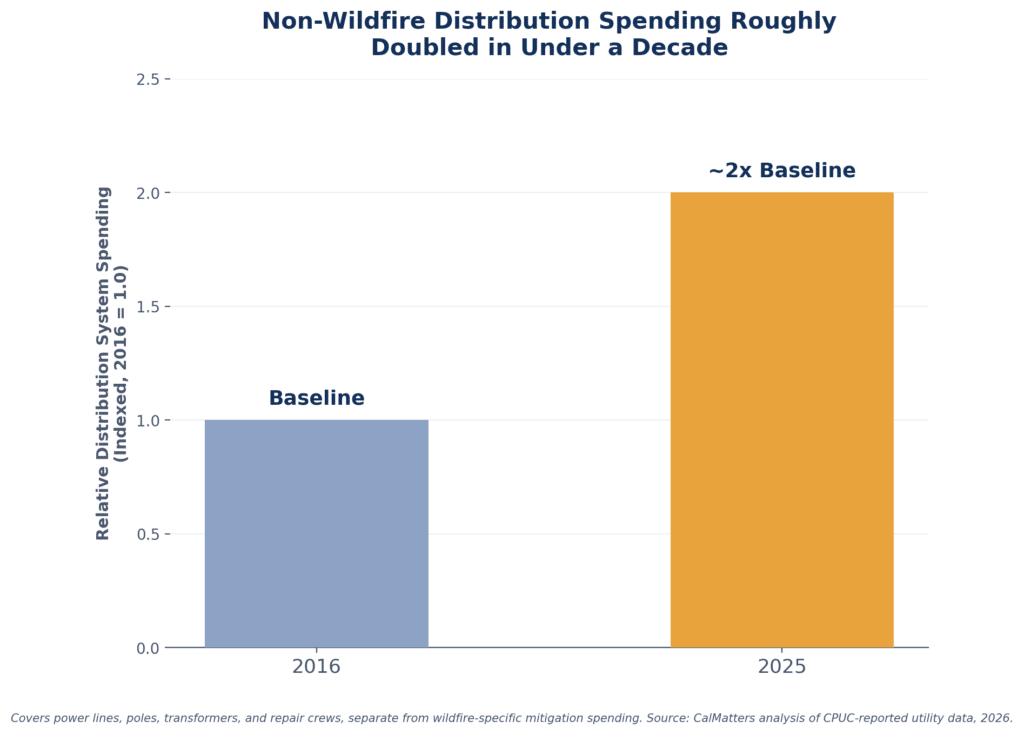
This is a significant part of why California moved to NEM 3.0 in 2023, a shift covered in detail in Why Backup Power Is Becoming Essential in California. It’s also not just a wildfire story: CalMatters’ analysis found that non-wildfire distribution spending, ordinary power lines, poles, transformers, and repair crews, roughly doubled between 2016 and 2025, part of a broader nationwide trend in grid investment.
How Do SCE and SDG&E Rate Increases Get Approved?
Through a formal CPUC process called a General Rate Case (GRC), typically filed every three to four years. The utility submits a detailed request for its authorized revenue requirement, covering infrastructure spending, wildfire mitigation, operations, and a return on equity for shareholders. The California Public Advocates Office and other intervening parties review and challenge the request, and the CPUC ultimately issues a decision setting the approved revenue level, which utilities then translate into per-kWh rates.
This isn’t a rubber stamp: the CPUC’s own 2026 vote on utility return-on-equity considered a 0.35% reduction to profit margins, though regulators and researchers alike note that spending on infrastructure and grid operations, not utility profit margins, is the larger factor pushing rates up. Between GRCs, utilities can also seek separate cost-recovery mechanisms specifically for wildfire mitigation and infrastructure programs, which is part of why bills can rise even in years without a full rate case.
Are Electric Rates Expected to Keep Rising in California?
Most signs point to continued upward pressure, though not necessarily every single rate adjustment. Utilities’ 2026-2028 wildfire mitigation plans call for substantially more capital spending than the prior cycle, including expanded undergrounding programs, and that spending flows directly into future rate cases. At the same time, individual adjustments can move in either direction in the short term: SCE’s average residential rate actually ticked down slightly across 2026, from about 35.3¢ to roughly 34.4¢ per kWh, even as the decade-long trend remains sharply upward. A newer factor is also emerging: rising electricity demand from AI data centers and vehicle and building electrification is adding structural upward pressure on top of the wildfire and grid-hardening spending already baked into the system.
How Does Solar Protect Against Future Rate Increases?
Solar locks in a meaningful share of your electricity cost against a rate structure that has moved up in one direction for most of the past decade, and pairing it with a battery adds a second layer of protection under NEM 3.0’s Time-of-Use pricing, letting you shift consumption away from the most expensive hours rather than paying whatever the utility charges in the moment.
This is exactly the dynamic that pushed California’s battery attachment rate from about 10% to about 60% after 2023, covered in full in Why Backup Power Is Becoming Essential in California. It’s also the reason backup power increasingly does double duty, protecting against both the outages covered in What Is a Public Safety Power Shutoff? and the rising cost of electricity itself.
How Can HomeLink Solar Help Lower My Exposure to Rising Rates?
HomeLink Solar (CSLB License #1117534) designs solar-plus-battery systems specifically to reduce your dependence on utility-set pricing, with an emphasis on ownership and fixed-payment pathways where available, since owning your system means you’re not exposed to the same rate trajectory as a household with no solar at all.
Owner Mandy oversees every install personally, with no subcontractors. See real completed installs on our our installs page, explore no-large-upfront-cost options through our Power Choice Program, compare us directly to a national provider in HomeLink vs. Sunrun, or get a free personalized quote.
California Electric Rates FAQs
Why are California electric rates among the highest in the country?
California has the second-highest electricity prices in the nation, behind Hawaii, driven primarily by wildfire-related distribution spending and, per CPUC’s own reporting, a rooftop solar cost-shift that added roughly $7 billion to non-solar customers’ bills in 2024 alone.
How do SCE and SDG&E rate increases get approved?
Through a formal CPUC General Rate Case process, typically every 3 to 4 years, where the utility requests an authorized revenue level, intervening parties challenge it, and the CPUC issues a final decision. Separate wildfire mitigation cost-recovery mechanisms can also affect bills between full rate cases.
Are electric rates expected to keep rising in California?
The underlying trend points upward, given 2026-2028 wildfire mitigation plans calling for more capital spending and emerging demand from AI data centers and electrification, though individual rate adjustments can occasionally move down in the short term even as the longer trend rises.
How does solar protect against future rate increases?
By locking in a share of your electricity cost outside the utility’s rate structure, and, paired with a battery, letting you shift usage away from the most expensive Time-of-Use pricing windows under NEM 3.0.
How can HomeLink Solar help lower my exposure to rising rates?
By designing a solar-plus-battery system sized to your household with an emphasis on ownership, so you’re not fully exposed to the same rate trajectory as a household with no solar, with owner Mandy personally overseeing every install.
Related Reading
See Why Backup Power Is Becoming Essential in California for the NEM 3.0 and battery-demand story, What Is a Public Safety Power Shutoff? and Generator vs Battery Backup: Which Is Better? for outage-specific planning, The Ultimate Home Emergency Checklist for full household preparedness, and How to Prepare Your Home for a Major California Earthquake.
Sources
- UC Berkeley Haas Energy Institute — Why California’s Electricity Bills Keep Climbing
- CPUC — 2025 SB 695 Report to the Legislature
- CalMatters — Lowering California’s High Utility Costs Takes More Than Flashy Slogans
- SAN.com — Wildfires and a ‘Black Box’ of Utility Spending Drive California’s Record Electric Rate Hikes
- SCE Rate Advisory (via industry reporting) — 2026 residential rate adjustments