1 megawatt (MW) = 1,000 kilowatts (kW) = 1,000,000 watts (W).
Whether you’re running a quick megawatt calculation for a solar quote or just trying to see how kilowatt and megawatt numbers relate, the answer is one line of math away.
To convert kW to MW, divide by 1,000. To convert MW to kW, multiply by 1,000. The same math applies to energy: 1 megawatt-hour (MWh) = 1,000 kilowatt-hours (kWh).
If you searched for a kilowatt to megawatt conversion, you’re probably staring at a number on a solar quote, a utility bill, or a spec sheet and trying to figure out what it actually means. This guide covers the formulas, the full conversion table, worked math for the exact numbers people search for most, and where kilowatts and megawatts actually show up in the real world, from your rooftop to a utility-scale solar farm.
We build and size solar and battery systems for California homes every day at HomeLink Solar, so this isn’t abstract math for us. Every number below ties back to how systems are actually measured and installed.
Quick Megawatt Calculation Answers
- 1 megawatt (MW) = 1,000 kilowatts (kW) = 1,000,000 watts (W)
- Kilowatt to megawatt: divide by 1,000 → kW ÷ 1,000 = MW
- Megawatt to kilowatt: multiply by 1,000 → MW × 1,000 = kW
- Kilowatts are used for home appliances and rooftop solar systems, typically 5–15 kW
- Megawatts are used for commercial and utility-scale solar farms
- Example megawatt calculation: 5,000 kW ÷ 1,000 = 5 MW
The Building Blocks: Watts, Kilowatts, Megawatts, Gigawatts, and Terawatts
Electricity is measured using the metric system, so every unit above a watt is just the watt multiplied by a power of 1,000. This isn’t a solar industry convention, it’s the International System of Units (SI), maintained by the National Institute of Standards and Technology (NIST).
- Watt (W)
the base unit of electrical power. It measures the rate energy is used or produced at a given moment, not a total amount. A 100-watt bulb draws 100 watts the entire time it’s switched on. - Kilowatt (kW)
1,000 watts. This is the unit used for home appliances (a hair dryer might draw 1.5 kW) and for sizing rooftop solar systems, which typically run 5 kW to 15 kW in California. - Megawatt (MW)
1,000 kilowatts, or 1,000,000 watts. This is where things stop being residential. Megawatts describe commercial systems, community solar projects, and utility-scale solar farms. - Gigawatt (GW)
1,000 megawatts. Used for state-level or national grid capacity. California’s total installed solar capacity is measured in gigawatts. - Terawatt (TW)
1,000 gigawatts. Reserved for national and global electricity statistics. Total U.S. electricity generating capacity is measured in low single-digit terawatts.
Kilowatt to Megawatt Conversion
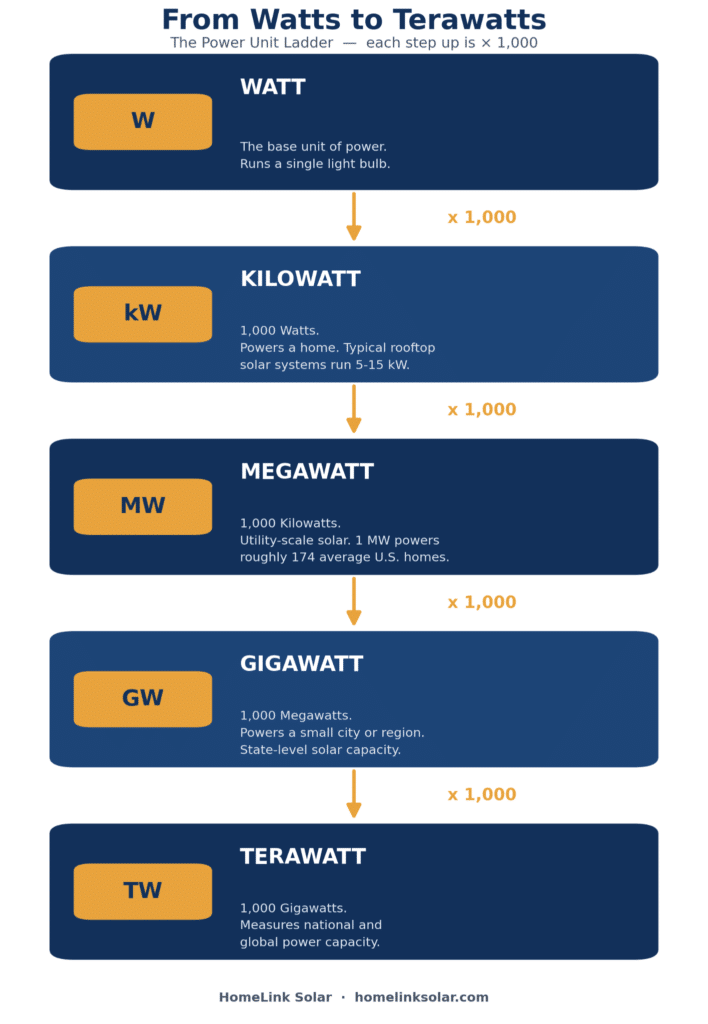
Every step up this ladder is exactly ×1,000. There’s no rounding, no regional variation, and no exceptions. That consistency is what makes the conversion formulas below so simple.
The Core Formula: How to Convert Kilowatts to Megawatts
Since 1 MW = 1,000 kW, the conversion runs in one direction by dividing, and the other by multiplying.
| Conversion | Formula |
|---|---|
| Kilowatts to Megawatts | MW = kW ÷ 1,000 |
| Megawatts to Kilowatts | kW = MW × 1,000 |
| Kilowatt-hours to Megawatt-hours | MWh = kWh ÷ 1,000 |
| Megawatt-hours to Kilowatt-hours | kWh = MWh × 1,000 |
Worked Examples: kW to MW
Here is the math worked out for the exact figures people look up most often:
| Input (kW) | Calculation | Result (MW) |
|---|---|---|
| 100 kW | 100 ÷ 1,000 | 0.1 MW |
| 500 kW | 500 ÷ 1,000 | 0.5 MW |
| 1,000 kW | 1,000 ÷ 1,000 | 1 MW |
| 1,500 kW | 1,500 ÷ 1,000 | 1.5 MW |
| 2,000 kW | 2,000 ÷ 1,000 | 2 MW |
| 2,500 kW | 2,500 ÷ 1,000 | 2.5 MW |
| 5,000 kW | 5,000 ÷ 1,000 | 5 MW |
| 7,500 kW | 7,500 ÷ 1,000 | 7.5 MW |
| 10,000 kW | 10,000 ÷ 1,000 | 10 MW |
| 25,000 kW | 25,000 ÷ 1,000 | 25 MW |
| 100,000 kW | 100,000 ÷ 1,000 | 100 MW |
Worked Examples: MW to kW
| Input (MW) | Calculation | Result (kW) |
|---|---|---|
| 0.5 MW | 0.5 × 1,000 | 500 kW |
| 1 MW | 1 × 1,000 | 1,000 kW |
| 1.32 MW | 1.32 × 1,000 | 1,320 kW |
| 2 MW | 2 × 1,000 | 2,000 kW |
| 5 MW | 5 × 1,000 | 5,000 kW |
| 10 MW | 10 × 1,000 | 10,000 kW |
| 25 MW | 25 × 1,000 | 25,000 kW |
| 50 MW | 50 × 1,000 | 50,000 kW |
Master Conversion Table: Watts, Kilowatts, Megawatts, and Gigawatts
This is the full reference table, spanning further in both directions than most conversion pages. Bookmark this section, it’s designed to answer almost any kW-MW lookup on one screen.
| Watts (W) | Kilowatts (kW) | Megawatts (MW) | Gigawatts (GW) |
|---|---|---|---|
| 1 W | 0.001 kW | 0.000001 MW | 0.000000001 GW |
| 100 W | 0.1 kW | 0.0001 MW | 0.0000001 GW |
| 500 W | 0.5 kW | 0.0005 MW | 0.0000005 GW |
| 1,000 W | 1 kW | 0.001 MW | 0.000001 GW |
| 5,000 W | 5 kW | 0.005 MW | 0.000005 GW |
| 6,000 W | 6 kW | 0.006 MW | 0.000006 GW |
| 10,000 W | 10 kW | 0.01 MW | 0.00001 GW |
| 50,000 W | 50 kW | 0.05 MW | 0.00005 GW |
| 100,000 W | 100 kW | 0.1 MW | 0.0001 GW |
| 500,000 W | 500 kW | 0.5 MW | 0.0005 GW |
| 1,000,000 W | 1,000 kW | 1 MW | 0.001 GW |
| 5,000,000 W | 5,000 kW | 5 MW | 0.005 GW |
| 10,000,000 W | 10,000 kW | 10 MW | 0.01 GW |
| 100,000,000 W | 100,000 kW | 100 MW | 0.1 GW |
| 1,000,000,000 W | 1,000,000 kW | 1,000 MW | 1 GW |
The base relationship, defined by the International System of Units and maintained by NIST, never changes: kilo = ×1,000, mega = ×1,000,000, giga = ×1,000,000,000.
Power vs. Energy: kW vs. kWh, and MW vs. MWh
This is where most confusion actually happens, and it’s worth slowing down for. A kilowatt (kW) and a kilowatt-hour (kWh) are not the same kind of measurement.
- Power (kW, MW) is a rate. It answers “how fast is electricity flowing right now?”
- Energy (kWh, MWh) is a total. It answers “how much electricity was used or produced over time?”
A 6 kW solar system doesn’t produce “6 kW” over the course of a day, it produces 6 kW at peak output, and that rate, sustained (and varying with sunlight) over hours, adds up to a number of kWh. This is also exactly why your utility bill is measured in kWh, not kW: it’s charging you for total energy delivered, not the momentary rate.
The same ×1,000 relationship applies to the energy units:
| Kilowatt-hours (kWh) | Megawatt-hours (MWh) |
|---|---|
| 100 kWh | 0.1 MWh |
| 500 kWh | 0.5 MWh |
| 1,000 kWh | 1 MWh |
| 5,000 kWh | 5 MWh |
| 10,000 kWh | 10 MWh |
| 10,791 kWh (avg. U.S. home, annual) | 10.791 MWh |
| 100,000 kWh | 100 MWh |
| 1,000,000 kWh | 1,000 MWh (1 GWh) |
Worked example: A 6 kW rooftop solar system, running at an average of 4.5 effective peak-sun hours a day in Southern California, produces approximately 6 kW × 4.5 hours = 27 kWh per day. Over a year, that’s roughly 9,855 kWh, or 9.855 MWh.
How Many Kilowatts Does a California Home Actually Need?
This is the calculation installers run behind the scenes on every quote. It comes down to two numbers: how much energy your household uses, and how much usable sunlight your roof gets.
According to the U.S. Energy Information Administration, the average U.S. residential customer used 10,791 kWh of electricity in 2022, or roughly 29.6 kWh per day.
Step-by-step sizing formula:
- Take your average daily electricity use in kWh (check your utility bill, or use the national average of ~29.6 kWh/day as a starting point).
- Divide by your region’s average peak sun hours per day (Southern California generally averages 5 to 6).
- The result is your approximate system size in kW.
Example: 29.6 kWh ÷ 5.5 peak sun hours ≈ 5.4 kW system.
This is why most HomeLink Solar residential installs fall between 5 kW and 15 kW, depending on household size, usage, and whether you’re also charging an EV or running a heat pump. If you want an exact number for your own roof and usage instead of a national average, that’s exactly what a free HomeLink Solar quote is for, our team pulls your actual utility data and roof specs rather than a national estimate.
How Big Is a Megawatt, Really? Homes, Farms, and Real Numbers
Kilowatts make sense at home. Megawatts are where things scale up to entire neighborhoods and utility infrastructure.
According to the Solar Energy Industries Association (SEIA), the current national average, through Q4 2025, is that 1 MW of installed solar capacity powers approximately 174 average U.S. homes. That figure has ranged between 150 and 210 homes per MW since SEIA started tracking it in 2012, depending on regional sunlight and system performance.
To make a megawatt tangible, here’s how it plays out at some of California’s largest utility-scale solar farms:
| Solar Farm | Location | Capacity (MW) | Approx. Homes Powered |
|---|---|---|---|
| Desert Sunlight Solar Farm | Riverside County, CA | 550 MW | ~160,000 homes |
| Topaz Solar Farm | San Luis Obispo County, CA | 550 MW | ~180,000 homes |
| Solar Star | Kern / Los Angeles Counties, CA | 579 MW | ~255,000 homes |
| Edwards & Sanborn Solar + Storage | Kern County, CA | 875 MW | ~238,000 homes |
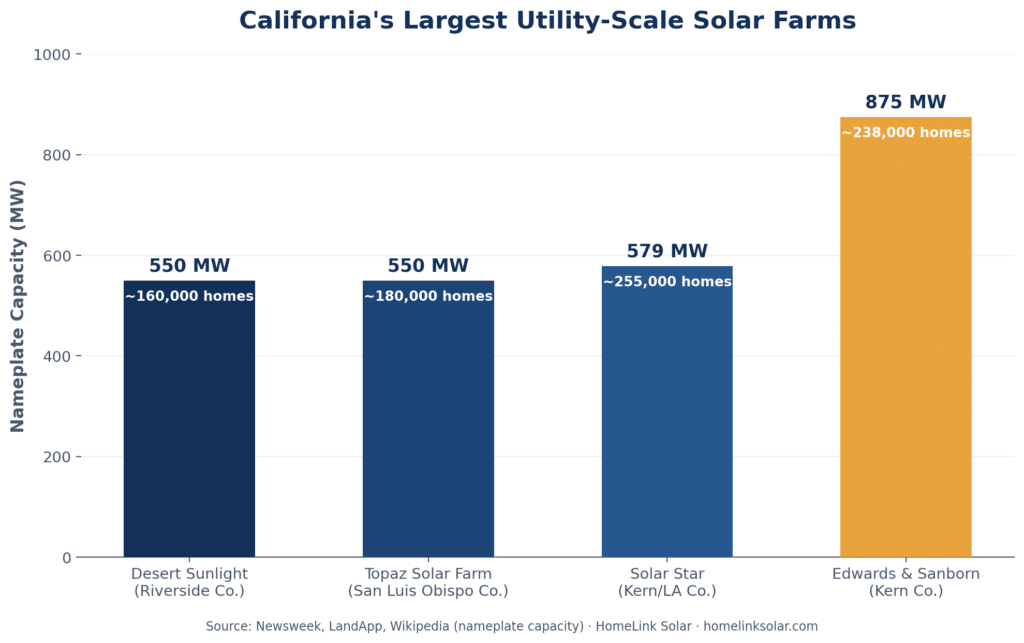
Compare that to a typical HomeLink Solar residential install (5–15 kW) and the scale difference is obvious: it would take roughly 58,000 to 175,000 individual home rooftop systems, sized between 15 kW and 5 kW respectively, to match the output of a single 875 MW utility-scale farm like Edwards & Sanborn. That’s the practical difference between why your roof is quoted in kilowatts and why a utility project is quoted in megawatts.
SRECs and Megawatt-Hours: Getting the Numbers Right
If you’ve read about earning money from your solar production through Solar Renewable Energy Credits (SRECs), here’s the detail that’s easy to get backwards: an SREC is earned per megawatt-hour (MWh) of energy produced, not per megawatt (MW) of capacity installed. One is a total amount of electricity generated; the other is a rate of production capacity. Confusing the two will throw off any estimate by orders of magnitude.
According to EnergySage, 1 SREC = 1 MWh (1,000 kWh) of solar electricity generated, and SREC markets exist mainly in states with a solar carve-out in their Renewable Portfolio Standard, think New Jersey, Maryland, Massachusetts, Pennsylvania, and Washington D.C.
Worth knowing if you’re a California homeowner: California does not currently have a traditional SREC market. Instead, California’s solar value comes primarily through Net Energy Metering (NEM) and, where available, programs like HomeLink’s Power Choice Program, which lets qualifying homeowners add solar and battery backup with no large upfront cost. If a national guide tells you to expect SREC income in California, that’s a sign it wasn’t written with California homeowners in mind.
Common Mistakes When Converting kW to MW
| Mistake | Why It Happens | Fix |
|---|---|---|
| Moving the decimal the wrong direction | kW → MW requires dividing (making the number smaller); it’s easy to multiply out of habit | Remember: MW is always the smaller number for the same amount of power |
| Confusing kW with kWh | Both appear on solar quotes and utility bills, one is a rate, one is a total | Ask “over what time period?” — if there’s no time period, it’s power (kW), not energy (kWh) |
| Treating MW as an annual output | Headlines say a farm “produces 550 MW,” which is a capacity, not a yearly total | Annual output is measured in MWh, capacity (nameplate rating) is measured in MW |
| Applying national averages to a specific home | National figures (like 29.6 kWh/day) don’t account for climate, home size, or EV charging | Use your actual utility bill data, or get a personalized quote |
Frequently Asked Questions
How many kilowatts are in a megawatt?
There are 1,000 kilowatts in 1 megawatt. The relationship is fixed by the International System of Units: mega always means ×1,000,000 relative to the base unit, and kilo always means ×1,000, so a megawatt is exactly 1,000 times larger than a kilowatt.
How do you convert kW to MW?
Divide the kilowatt value by 1,000. For example, 7,500 kW ÷ 1,000 = 7.5 MW.
How do you convert MW to kW?
Multiply the megawatt value by 1,000. For example, 2.5 MW × 1,000 = 2,500 kW.
What is the difference between a kilowatt and a megawatt?
Both measure electrical power, the rate electricity is produced or used. The only difference is scale: a megawatt is 1,000 times larger than a kilowatt. Kilowatts are used for home appliances and residential solar systems (typically 5–15 kW). Megawatts describe commercial and utility-scale power, like solar farms or grid capacity.
How many kWh are in a MWh?
There are 1,000 kilowatt-hours in 1 megawatt-hour, the same ×1,000 relationship as kW to MW, just applied to energy (a total amount) instead of power (a rate).
What is the formula for calculating megawatts?
MW = kW ÷ 1,000. If you’re starting from watts, the formula is MW = W ÷ 1,000,000. Both formulas come from the same base SI relationship: 1 MW = 1,000,000 W.
How many homes can one megawatt of solar power?
According to SEIA’s most recent figures (through Q4 2025), 1 MW of installed solar capacity powers approximately 174 average U.S. homes. This number varies by state, since it depends on local sunlight levels and each state’s average household electricity use.
Why are home solar systems measured in kilowatts instead of megawatts?
Because residential systems are small relative to a megawatt. A typical California home system runs 5–15 kW, which is 0.005 to 0.015 MW, an awkward number of decimal places to quote a homeowner. Kilowatts keep the number in a simple, readable range for home-sized systems.
How many kW do I need for my home?
As a rough estimate, divide your average daily electricity use (in kWh) by your area’s average peak sun hours. Using the national average of 29.6 kWh/day and 5.5 peak sun hours (typical for Southern California), that works out to roughly 5.4 kW. Actual sizing depends on your specific usage, roof, and shading, which is why a personalized quote gives a more accurate number than any national formula.
Is a gigawatt bigger than a megawatt?
Yes. A gigawatt is 1,000 times larger than a megawatt, and 1,000,000 times larger than a kilowatt. The full ladder, from smallest to largest, is: watt → kilowatt → megawatt → gigawatt → terawatt, with each step representing another ×1,000.
What is a megawatt calculation?
A megawatt calculation is any conversion that starts in kilowatts or watts and scales up to megawatts. The formula never changes: MW = kW ÷ 1,000, or MW = W ÷ 1,000,000. Most homeowners run into a megawatt calculation when comparing a solar quote (in kW) against a utility-scale project or grid figure quoted in MW.
How many kW per MW?
There are 1,000 kW in every MW. That ratio never changes, whether you’re comparing a 5 kW rooftop system or an 875 MW utility-scale farm.
What is kilowatt hour to megawatt hour?
One megawatt-hour (MWh) equals 1,000 kilowatt-hours (kWh), so converting kilowatt hour to megawatt hour means dividing the kWh number by 1,000. It’s the same ×1,000 relationship as kW to MW, just applied to a total amount of energy instead of a moment-to-moment rate.
Is kWh the same as MW?
No. kWh measures energy (a total amount used or produced), and MW measures power (a rate). They describe different things, so there’s no direct kWh-to-MW conversion. If you have a kWh figure and want to compare it at megawatt scale, convert it to MWh instead (divide by 1,000), or, if you know the time period, multiply your kW rate by the number of hours to get kWh, then scale from there.
The math itself is simple: every step up the power-unit ladder is ×1,000. What actually matters is knowing which unit applies to your situation, kilowatts for your roof, megawatts for the grid, and kWh or MWh whenever you’re talking about total energy instead of a momentary rate.
If you’re trying to figure out how many kW your home actually needs, or want to see how a HomeLink Solar system compares to other providers, our team can build you a real, personalized number instead of a national average. See our completed installs, compare us directly on our HomeLink vs. Sunrun page, or get a free personalized quote to see your exact system size.
Sources
- NIST — Metric (SI) Prefixes
- U.S. Energy Information Administration — How much electricity does an American home use?
- SEIA — What’s in a Megawatt
- EnergySage — SRECs: What are Solar Renewable Energy Credits?
- Wikipedia — Topaz Solar Farms
- Newsweek — 5 Biggest Solar Projects in the US
- LandApp — Largest Solar Farms in the U.S.