More than 4.5 million at-risk Medicare beneficiaries rely on electricity-dependent durable medical equipment at home, according to the federal HHS emPOWER Program, and that figure doesn’t include younger patients, privately insured households, or family caregivers managing the same equipment. If a power outage is a serious inconvenience for most households, it’s a genuine safety issue for a home running a ventilator or an oxygen concentrator. This guide covers exactly which devices need continuous power, how much electricity they actually draw, and how to size backup power around them specifically, not as an afterthought on a generic checklist.
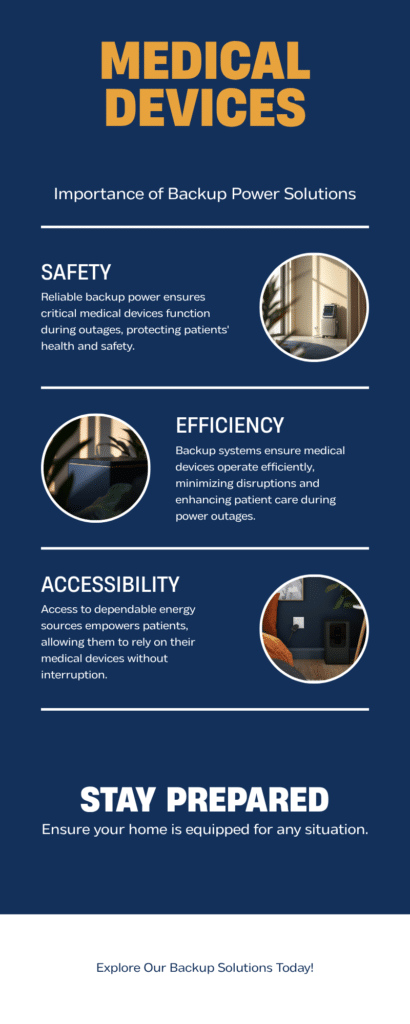
Which Common Medical Devices Require Continuous Power?
More than people usually assume, and the wattage varies a lot by device. A peer-reviewed study in Nature Scientific Reports examining the electricity cost burden of durable medical equipment identified oxygen concentrators, home dialysis equipment, ventilators, CPAP and BiPAP machines, nebulizers, mobility scooters, hospital beds, feeding pumps, infusion pumps, and suction machines as the most common electricity-dependent devices in home use. Ventilators and dialysis equipment are the most safety-critical, ventilators in particular cannot tolerate even brief interruptions without risking the patient directly.
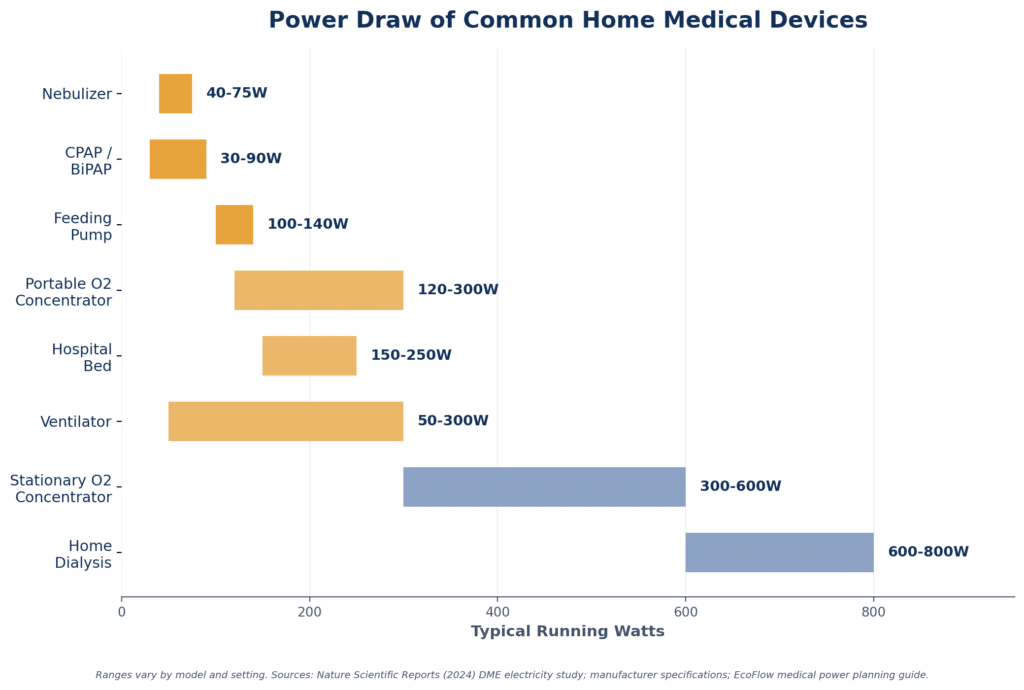
A few specifics worth knowing: CPAP and BiPAP machines are genuinely light loads, typically 30 to 90 watts, running around 7 to 8 hours overnight. Oxygen concentrators vary widely by model and flow rate, portable units often run 120 to 300 watts, while stationary home units commonly draw 300 to 600 watts, continuously. Ventilators run 50 to 300 watts depending on the model. Home dialysis equipment is one of the heavier loads on this list, commonly 600 to 800 watts during a treatment session. Don’t rely on a rule of thumb for your own equipment, the exact number is printed on the device’s label as volts and amps; multiplying the two gives you the actual watts.
How Long Can a Battery Backup System Run a CPAP Machine or Oxygen Concentrator?
Comfortably, in most cases, because these are lighter loads relative to a typical home battery’s capacity. A single 13.5 kWh home battery, the capacity of a Tesla Powerwall 3, running only a CPAP machine at roughly 60 watts average, would last on the order of 9 days continuously, far beyond what any realistic outage requires. A stationary oxygen concentrator at 450 watts is a heavier draw, but still only about 30 hours on that same battery running alone. In a realistic household scenario, a CPAP machine, an oxygen concentrator, a refrigerator, Wi-Fi, and phone charging running together might draw roughly 700 to 750 watts combined, which still gives you close to a full day of runtime on a single battery, and indefinitely longer if solar is recharging it during the day. For the full math across other household loads, see How Long Can a Home Battery Power Your House?
What’s the Difference Between a UPS and a Whole-Home Battery for Medical Needs?
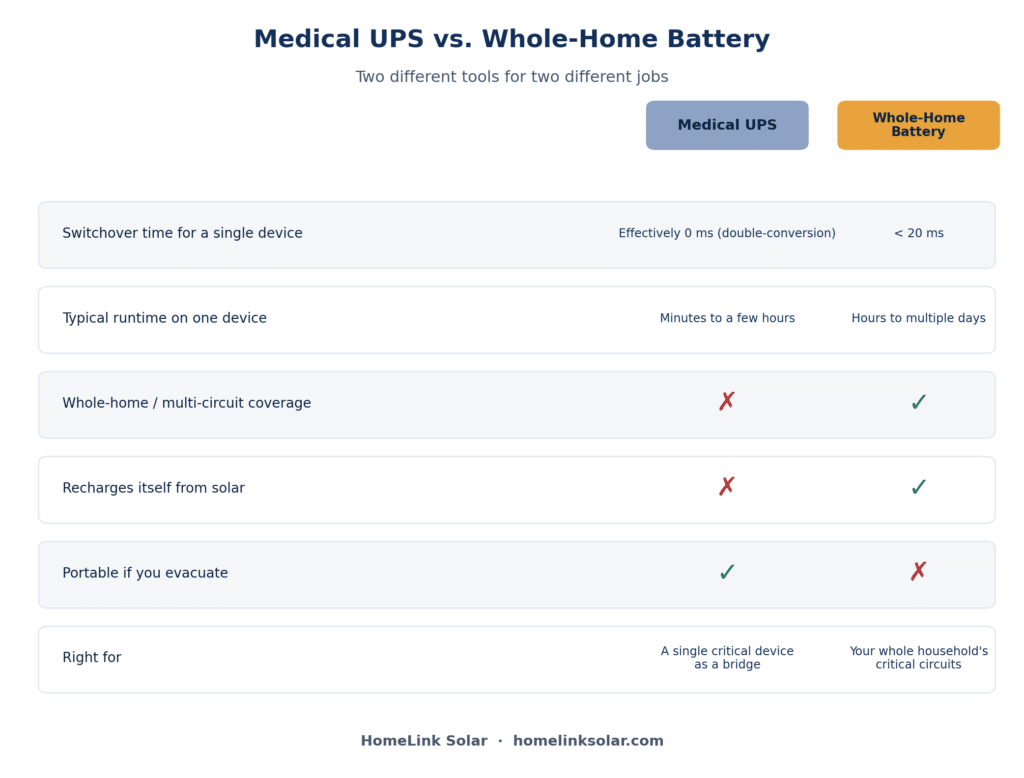
They solve different problems, and a lot of confusion comes from treating them as interchangeable. An uninterruptible power supply, commonly called a UPS, is a small, dedicated battery unit built to bridge a single device through the moment power drops, some designs offer effectively zero switchover time since they’re continuously converting power rather than switching to it. That makes a UPS an excellent bridge for something like a ventilator during the seconds before a generator or battery system takes over, but its own runtime is typically minutes to a few hours, and it covers only what’s plugged directly into it. A whole-home battery is a different category of product entirely, sized to cover multiple circuits across your house for hours to multiple days, and, paired with solar, able to recharge itself for as long as an outage lasts.
Should Medical Equipment Circuits Be Prioritized When Sizing a System?
Yes, ahead of almost everything else on a critical-loads list. Medical equipment is usually a light-to-moderate electrical load, which means it’s inexpensive to include, but the cost of not including it isn’t measured in spoiled food, it’s measured in patient safety. A well-designed critical-loads plan puts medical devices on the same priority tier as refrigeration and communication, and for a household running a ventilator or dialysis equipment specifically, on its own dedicated, clearly labeled circuit with no ambiguity about what’s protected.
Register With Your Utility’s Medical Baseline Program
This is a real, often underused protection that costs nothing. Both SCE and SDG&E maintain Medical Baseline programs that provide priority PSPS notification, and in some cases additional support, for customers who depend on powered medical equipment, something we cover in How to Prepare for California PSPS Power Shutoffs. Per guidance from patient advocacy organizations working on disaster preparedness, households should also ask their utility directly whether it maintains a separate life-sustaining equipment or critical-care customer list. Enrollment doesn’t guarantee uninterrupted power, but it can mean earlier notification and, in some cases, priority restoration consideration, neither of which happens automatically.
Can HomeLink Solar Prioritize Medical Equipment Circuits in a Custom Install?
Yes. HomeLink Solar (CSLB License #1117534) sizes every battery system around the household’s actual critical circuits, and for homes with medical equipment, that means treating those devices as a named priority from the start of the design, not an assumption. Owner Mandy oversees every install personally, with no subcontractors. See real completed installs on our our installs page, explore no-large-upfront-cost options through our Power Choice Program, or get a free personalized quote.
FAQs
1. Which common medical devices require continuous power?
Oxygen concentrators, home dialysis equipment, ventilators, CPAP and BiPAP machines, nebulizers, mobility scooters, hospital beds, feeding pumps, infusion pumps, and suction machines, per a peer-reviewed study of durable medical equipment power use. Ventilators and dialysis equipment are the most critical.
2. How long can a battery backup system run a CPAP machine or oxygen concentrator?
A CPAP machine (around 60 watts) could run over a week on a single 13.5 kWh home battery running alone. A stationary oxygen concentrator (around 450 watts) would run roughly 30 hours alone, and longer combined with other loads if solar is recharging the battery.
3. What’s the difference between a UPS and a whole-home battery for medical needs?
A UPS bridges a single device for minutes to a few hours with minimal or zero switchover time. A whole-home battery covers multiple circuits for hours to multiple days and can recharge from solar, a different tool for a different scale of need.
4. Should medical equipment circuits be prioritized when sizing a system?
Yes. Medical devices are typically light to moderate loads, inexpensive to include, and the safety stakes of leaving them out are much higher than for most other household circuits.
5. Can HomeLink Solar prioritize medical equipment circuits in a custom install?
Yes, medical equipment is treated as a named priority in the system design from the start, with owner Mandy personally overseeing every install.
Related Reading
See How Long Can a Home Battery Power Your House?, How to Prepare for California PSPS Power Shutoffs, The Ultimate Home Emergency Checklist, and Generator vs Battery Backup: Which Is Better?
Sources
- Nature Scientific Reports — The Electricity Cost Burden of Durable Medical Equipment in the United States
- HHS Administration for Strategic Preparedness and Response — HHS emPOWER Program Executive Summary
- Ready.gov — Power Outages
- CDC — Power Sources, Prepare Your Health
- Accessia Health — Disaster Preparedness with Chronic Health Needs