“A few hours” and “most of a week” have both been true answers to how long a PSPS lasts, depending on the year, the utility, and the weather event. This piece goes past the general guidance in our other PSPS posts and into the actual reported numbers, pulled from CPUC-reported utility data, to answer the question homeowners actually want answered: realistically, how long could you be without power? See What Is a Public Safety Power Shutoff? and How to Prepare for California PSPS Power Shutoffs for the trigger conditions and notification process this data builds on.
What’s the Average Length of a PSPS Shutoff in Southern California?
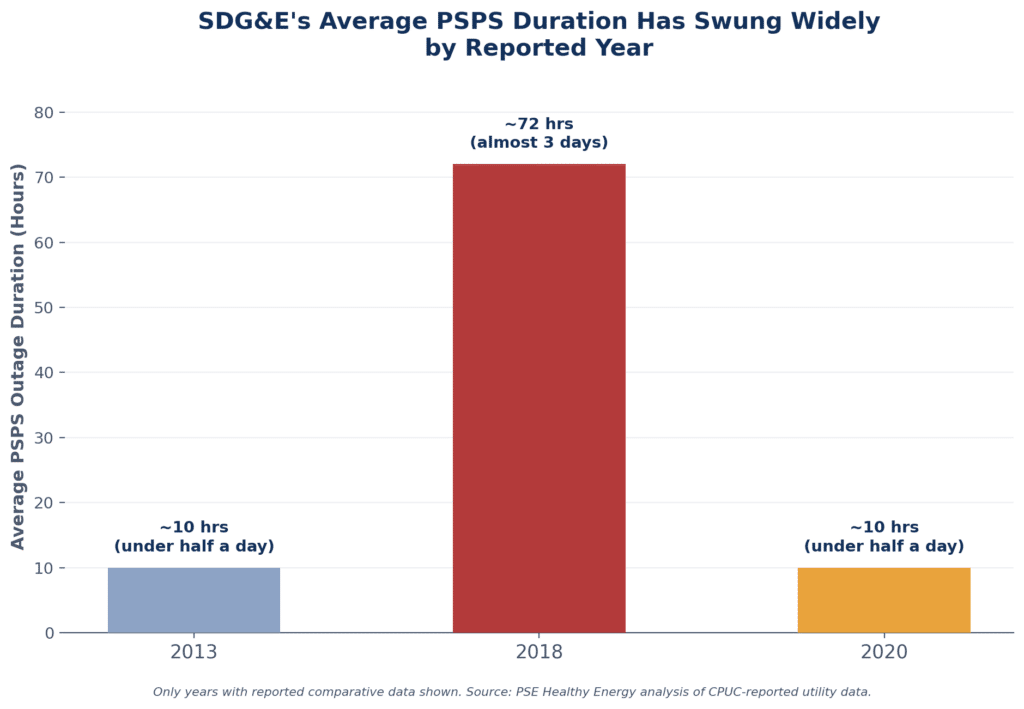
It varies more by year than most people expect, and the data shows why. According to an analysis by PSE Healthy Energy of CPUC-reported utility data, SDG&E’s average PSPS outage ran less than half a day in 2013, grew to almost 3 days in 2018, and then fell back to less than half a day by 2020, evidence that utilities have gotten meaningfully better at narrowing and shortening events as forecasting and situational awareness improved. PG&E’s data tells a similar story from the other direction: 2018 was its best reported year, with all customers restored within 2 days, while 2019 was its worst, with some customers without power for almost a week and half of all affected customers out for at least 2 days.
A Real Event, in Real Numbers
Averages can hide what an actual event looks like on the ground, so here’s one, drawn from SDG&E’s own PSPS Performance and Lessons Learned briefing to the CPUC. During the Thanksgiving 2021 Red Flag Warning event (November 24-26), SDG&E notified 54,527 customers of a possible shutoff. In the end, 5,858 customers actually lost power, roughly one in ten. The average outage among those affected ran 25 hours 13 minutes; the longest single outage ran 42 hours 11 minutes.
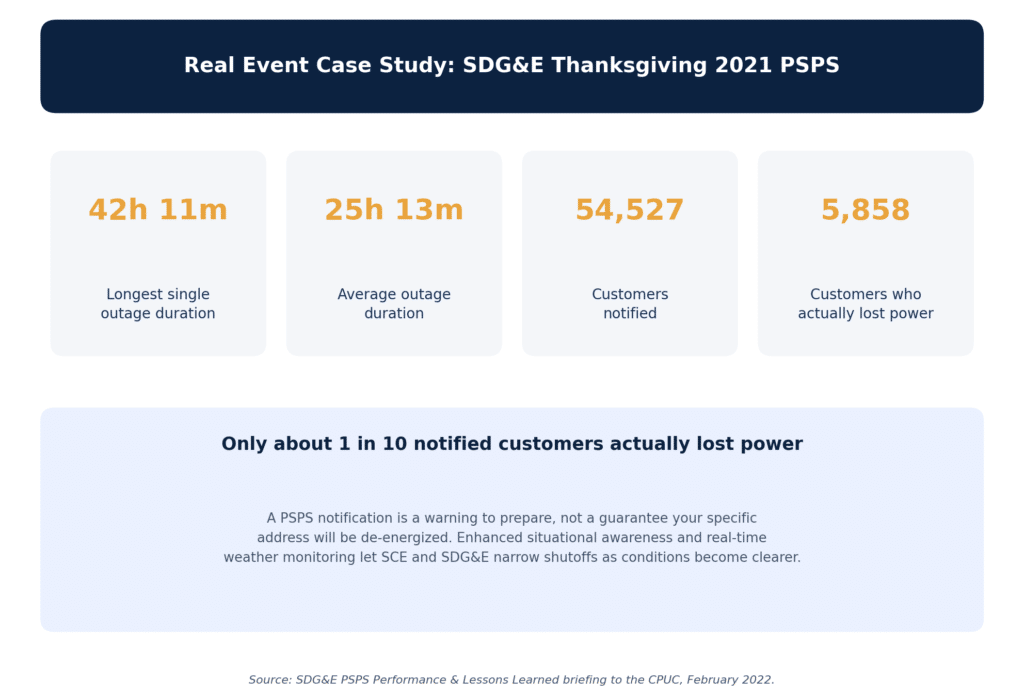
The gap between “notified” and “actually affected” matters for how you interpret an alert: a PSPS notification means your area is at risk and you should prepare as if power will go out, not that it definitely will. Real-time weather monitoring and field observations let utilities narrow the actual shutoff footprint considerably as the event unfolds.
Can a PSPS Shutoff Last More Than 48 Hours?
Yes, and the data above shows it isn’t rare. SDG&E’s own 2018 average approached 3 full days, and PG&E’s 2019 data shows some customers out for nearly a week. The Thanksgiving 2021 event’s longest single outage, at just over 42 hours, was already close to two full days for one circuit even though the average across all affected customers was lower. Planning around a strict 24 to 48 hour window is planning for the typical case, not the worst case, and multi-day events are well-documented in the utilities’ own reporting.
How Do I Get PSPS Alerts for My Address?
Sign up directly with your utility rather than relying on news coverage, which often lags real notifications. SCE customers can register for alerts and check the PSPS Weather Dashboard through sce.com. SDG&E customers can sign up through the SDGE Alerts app or sdge.com/ready, which also lists open Community Resource Centers during an active event. For historical lookups, the CPUC’s Public PSPS Dashboard lets you check whether a specific address has been impacted by a PSPS event since October 2021. If anyone in your household depends on powered medical equipment, enroll in your utility’s Medical Baseline program for priority notification, covered in more detail in How to Prepare for California PSPS Power Shutoffs.
What’s the Cost of Being Unprepared for a Multi-Day PSPS?
It adds up faster than most people budget for. A typical refrigerator’s contents cost around $200 to replace, and standard homeowners insurance food-spoilage coverage is usually capped at $500 to $1,000, meaning a bad multi-day event can still cost you out of pocket even with coverage, a topic we cover in more depth in our refrigerator-specific guide. Add in lost remote-work productivity (a single day without power can mean a full day’s wages for an hourly worker), spoiled refrigerated medication, and emergency supply runs, and an unprepared multi-day PSPS routinely costs a household several hundred dollars in avoidable losses, on top of the disruption itself.
How Does HomeLink Solar Keep Homes Powered Through Extended PSPS Events?
HomeLink Solar designs solar-plus-battery systems specifically to handle the multi-day reality shown in the data above, not just a best-case 24-hour outage. That means sizing battery capacity around your actual critical loads and pairing it with solar so the system recharges every day an event continues, whether it lasts the average 25 hours or stretches toward a week like PG&E’s worst reported year. Owner Mandy oversees every install personally, with no subcontractors. See our full ranked comparison of backup options in Best Backup Power Options During Wildfires, explore no-large-upfront-cost options through our Power Choice Program, or get a free personalized quote.
FAQs
What’s the average length of a PSPS shutoff in Southern California?
It varies significantly by year. SDG&E’s reported average ran under half a day in 2013 and 2020, but nearly 3 days in 2018. A real 2021 event averaged 25 hours 13 minutes among affected customers, with the longest single outage at 42 hours 11 minutes.
Can a PSPS shutoff last more than 48 hours?
Yes. SDG&E’s 2018 average approached 3 days, and PG&E reported some customers without power for nearly a week in 2019. Multi-day events are documented in the utilities’ own CPUC reporting, not rare exceptions.
How do I get PSPS alerts for my address?
Register directly through your utility: SCE via sce.com, SDG&E via the SDGE Alerts app or sdge.com/ready. Use the CPUC’s Public PSPS Dashboard to check your address’s history since October 2021.
What’s the cost of being unprepared for a multi-day PSPS?
Often several hundred dollars per event: roughly $200 to replace a refrigerator’s contents, potential lost wages for remote workers, spoiled medication, and emergency supply costs, much of which standard insurance coverage doesn’t fully offset.
How does HomeLink Solar keep homes powered through extended PSPS events?
By sizing solar-plus-battery systems around real multi-day scenarios, not just a best-case 24-hour outage, so the battery keeps recharging from solar for as long as the event actually lasts.
Related Reading
See What Is a Public Safety Power Shutoff?, How to Prepare for California PSPS Power Shutoffs, and Best Backup Power Options During Wildfires. For appliance-specific planning, see What Happens to Refrigerators During Extended Outages? and How Long Can a Home Battery Power Your House? For programs with no large upfront cost, see our Power Choice Program.
Sources
- PSE Healthy Energy — Preventing Wildfires with Power Outages: the Growing Impacts of California’s PSPS
- SDG&E / CPUC — PSPS Performance & Lessons Learned Briefing, February 2022
- CPUC — Public Safety Power Shutoffs (PSPS) / Public PSPS Dashboard
- SCE — PSPS FAQs
- SDG&E — PSPS More Info