FEMA’s official Ready.gov framework breaks preparedness into three parts: get a kit, make a plan, be informed. Most checklists online stop at part one. This guide covers all three, with a specific focus on California’s actual hazard profile, and links out to our detailed item-by-item supply list and hazard-specific guides rather than repeating them here.
What Should Be Included in a Whole-Home Emergency Checklist?
Three layers, not one. Supplies: water, food, first aid, light, and communication tools, covered item by item in 25 Things Every California Family Should Have Before the Next Power Outage. A plan: how your household communicates, where you meet, and how you decide between sheltering in place and evacuating, covered below. Backup power: a real answer for what stays running and for how long, which is where a supply list alone runs out of usefulness.
Know Your Risks: California’s Actual Hazard Profile
A generic national checklist doesn’t account for the fact that California’s specific risks compound each other in ways many states don’t deal with. Earthquake risk is statewide and largely unpredictable in timing, covered in How to Prepare Your Home for a Major California Earthquake. Wildfire risk brings both direct fire danger and Public Safety Power Shutoffs, planned outages that can hit even homes nowhere near an actual fire, covered in What Is a Public Safety Power Shutoff? and How to Prepare for California PSPS Power Shutoffs. Extreme heat and, in some regions, flood risk from atmospheric river storms round out the list. The overlap matters: a household that’s only prepared for one hazard type often discovers its plan doesn’t hold up when a different one hits.
Make a Family Communication and Evacuation Plan
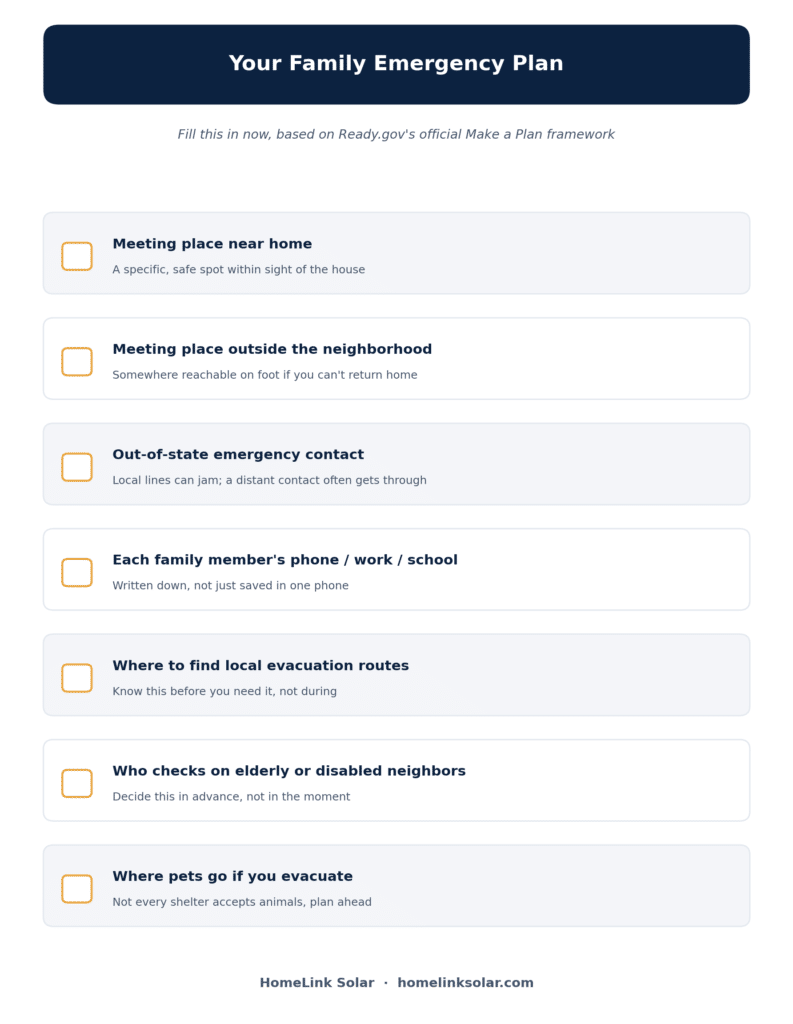
This is the part most home emergency checklists skip entirely, and it’s arguably more important than any single item on a supply list. Per Ready.gov’s official Make a Plan guidance, every household should establish two specific things before an emergency, not during one: a meeting place near your home for sudden situations like a fire, and a second meeting place outside your neighborhood in case you can’t return home at all. Add an out-of-state emergency contact, since local phone lines and cell towers can jam during a widespread event while a long-distance call often still connects. Write down phone numbers and addresses for schools and workplaces rather than relying entirely on saved contacts in one phone.
Decide in advance how you’ll choose between sheltering in place and evacuating. As a general rule: shelter in place if your home is structurally sound and you have adequate supplies; evacuate if you see structural damage, if officials issue an evacuation order, or if a wildfire or flood makes staying unsafe. Keep your gas tank at least half full year-round, evacuation routes can turn a short errand into a long drive, and gas stations lose power along with everyone else.
How Many Days of Supplies Should a California Household Keep on Hand?
More than the classic “72 hours” that most people have heard. That number is FEMA’s historical minimum, based on typical response times before local or federal aid arrives. But FEMA’s own current guidance encourages households to build toward a 7 to 14 day supply where storage space allows, and California’s specific hazard mix is a real reason to take that seriously rather than treat 72 hours as sufficient. PG&E reported some customers without power for almost a week during a single 2019 PSPS event, and major earthquakes can disrupt infrastructure, roads, and stores for well beyond three days. Start with 72 hours if that’s all you have room for, but treat it as a floor, not a target.
How Do Backup Power and Generators Fit Into an Emergency Plan?
This is where most generic checklists stop being useful, since “flashlights and batteries” is not a power plan. A real backup power plan starts with knowing which circuits actually matter (refrigerator, medical equipment, Wi-Fi, at minimum) and choosing a solution that matches how long your realistic risk actually lasts, not just the manufacturer’s best-case number. We rank every backup power option, including why generators specifically carry more risk during wildfire conditions, in Best Backup Power Options During Wildfires, and cover the real math on runtime by load in How Long Can a Home Battery Power Your House? For how long a real event tends to last in California specifically, see How Long Do PSPS Power Shutoffs Really Last in California?, which uses real CPUC-reported data rather than a generic estimate.
How Is a Home Emergency Checklist Different From a Car Emergency Kit?
They solve different problems and share almost no items in common. Per Ready.gov’s official car safety guidance, a car kit is built around getting you through being stranded, not sheltering in place for days.
| Home Emergency Kit | Car Emergency Kit |
|---|---|
| 3-day (ideally 7 to 14 day) water and food supply | Jumper cables |
| First aid kit, prescription medications | Flares or a reflective triangle |
| Battery or hand-crank NOAA weather radio | Ice scraper |
| Backup power plan (portable or whole-home) | Car cell phone charger |
| Copies of documents, cash, local maps | Blanket |
| Gas shutoff wrench, fire extinguisher | Cat litter or sand, for tire traction |
Ideally you have both, a home kit for sheltering in place and a smaller kit in each vehicle for being stranded on the road, since evacuation orders and everyday breakdowns both happen without much warning.
Documents, Insurance, and Financial Preparedness
Beyond copies of IDs and insurance policies covered in our supply checklist, one California-specific detail is worth calling out directly: standard homeowners insurance in California typically does not include earthquake coverage by default, it’s a separate policy or rider. If you haven’t confirmed this with your provider, that’s worth doing before an event, not after one. Keep a small emergency cash reserve as well, since card readers and ATMs commonly go down along with the power grid.
Practice and Review Your Plan
A plan that exists only on paper isn’t much better than no plan. Walk through it with your household at least once a year, ideally alongside restocking your supply kit. Run a real drill: practice the Drop, Cover, and Hold On response for earthquakes, physically walk to your outside-the-neighborhood meeting place so it’s not just a name on a list, and confirm every family member actually knows the out-of-state contact’s phone number rather than assuming it’s saved somewhere. Plans that have been rehearsed hold up better under real stress than plans that have only been written down.
Can HomeLink Solar Help Build a Whole-Home Emergency Power Plan, Not Just a Kit?
Yes. HomeLink Solar (CSLB License #1117534) designs solar-plus-battery systems that function as the power layer of a real emergency plan, sized around your household’s specific critical circuits and California’s actual hazard timelines, not a generic backup package. Owner Mandy oversees every install personally, with no subcontractors. Explore real completed installs on our our installs page, no-large-upfront-cost options through our Power Choice Program, general education on our Learn hub, or get a free personalized quote.
FAQs
What should be included in a whole-home emergency checklist?
Three layers: a stocked supply kit, a written and practiced family communication and evacuation plan, and a real backup power plan sized around your specific critical circuits, not just flashlights and batteries.
How is a home emergency checklist different from a car emergency kit?
They share almost no items. A home kit is built for sheltering in place for days; a car kit (jumper cables, flares, an ice scraper, a blanket) is built for being stranded on the road for hours. Ideally you have both.
How do backup power and generators fit into an emergency plan?
Backup power is the piece that turns a supply list into an actual plan: knowing which circuits matter, choosing a solution sized to your realistic outage duration, and understanding why generators carry extra risk during wildfire conditions specifically.
How many days of supplies should a California household keep on hand?
FEMA’s official minimum is 72 hours, but current guidance encourages building toward 7 to 14 days. California’s earthquake and PSPS risk, including real events that have kept some households without power for nearly a week, are a good reason to treat 72 hours as a floor rather than a target.
Can HomeLink Solar help build a whole-home emergency power plan, not just a kit?
Yes, by sizing a solar-plus-battery system around your household’s specific critical circuits and California’s actual hazard timelines, with owner Mandy personally overseeing every install.
Related Reading
See 25 Things Every California Family Should Have Before the Next Power Outage for the full item-by-item supply list, and the rest of our preparedness library: How to Prepare Your Home for a Major California Earthquake, What Is a Public Safety Power Shutoff?, How to Prepare for California PSPS Power Shutoffs, How Long Do PSPS Power Shutoffs Really Last in California?, Best Backup Power Options During Wildfires, and How Long Can a Home Battery Power Your House?
Sources
- Ready.gov / FEMA — Ready.gov Home (Get a Kit / Make a Plan / Be Informed framework)
- Ready.gov / FEMA — Make a Plan
- Ready.gov / FEMA — Car Safety
- Ready.gov / FEMA — Build a Kit