What an SDG&E shutoff is
A Public Safety Power Shutoff, or PSPS, is a temporary power shutoff in specific areas during extreme fire weather. San Diego Gas & Electric (SDG&E) says it uses one only when strong winds and dry conditions create a significant risk that electrical equipment could spark a wildfire.
SDG&E weighs wind speed and direction, temperature and humidity, dry vegetation, ground inspections and input from fire agencies. This guide covers PSPS only. It is different from a planned outage for maintenance, an unplanned outage, or a shutoff for late payment.
Notice you can expect
SDG&E describes a sequence of notices. These are the windows from its PSPS page:
| When | What SDG&E does |
|---|---|
| 3 to 10 days ahead | Monitors fire risk and may begin public safety and regional notifications. |
| About 48 hours before | Begins notifying customers of a possible PSPS. |
| About 24 hours before | Sends a follow-up notice if the risk continues and a shutoff is still likely. |
| A few hours before | Sends a confirmation with the start time. |
| When power goes off | Tells customers the PSPS has begun and lists Community Resource Center addresses and hours. |
| During and after | Sends regular updates on weather, safety patrols and estimated restoration times, then a final notice when service is back. |
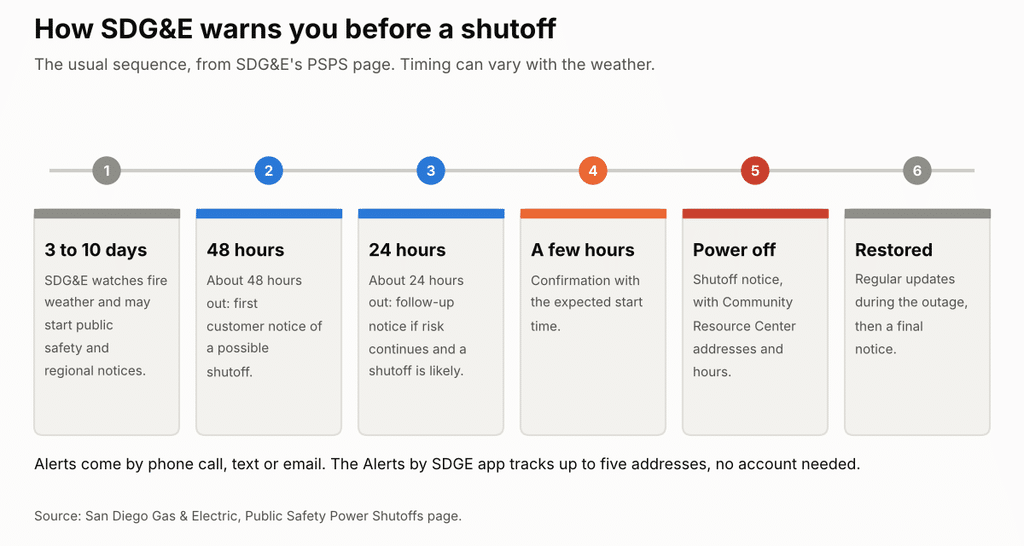
SDG&E sends alerts by phone call, text message, email or all three. You can update your contact details at sdge.com/notifications or in My Energy Center. The free Alerts by SDGE app also sends push notifications for outages and PSPS events. Check your contact details now. Do not wait for a warning to find out SDG&E has an old phone number.
How to check your address
- Open SDG&E’s outage map at outage.sdge.com to see outages that are happening now.
- Check the PSPS page at sdge.com/PSPS. It shows a seven-day PSPS forecast and links to the latest information at sdgetoday.com.
- Download the Alerts by SDGE app. It tracks up to five addresses and shows a map of impacted areas, estimated restoration times and the nearest Community Resource Centers. You do not need an SDG&E account to use it.
During an event, SDG&E also posts a list of impacted communities at sdge.com/ready.
The October 2026 event shows what a real one looks like. According to Times of San Diego, SDG&E planned shutoffs from 5 a.m. Friday, Oct 2, through 6 p.m. Monday, Oct 5, because of Santa Ana winds and extreme heat. Nearly 35,000 customers in North, East and South County could lose power, across more than 30 communities, including El Cajon, Poway, Julian, Ramona and Valley Center. That is a window of about four days, which is why planning for more than a few hours matters.
How long shutoffs last
SDG&E says a PSPS can last from several hours to multiple days, depending on the weather and on inspection and repair time. Power stays off until conditions no longer threaten its equipment.
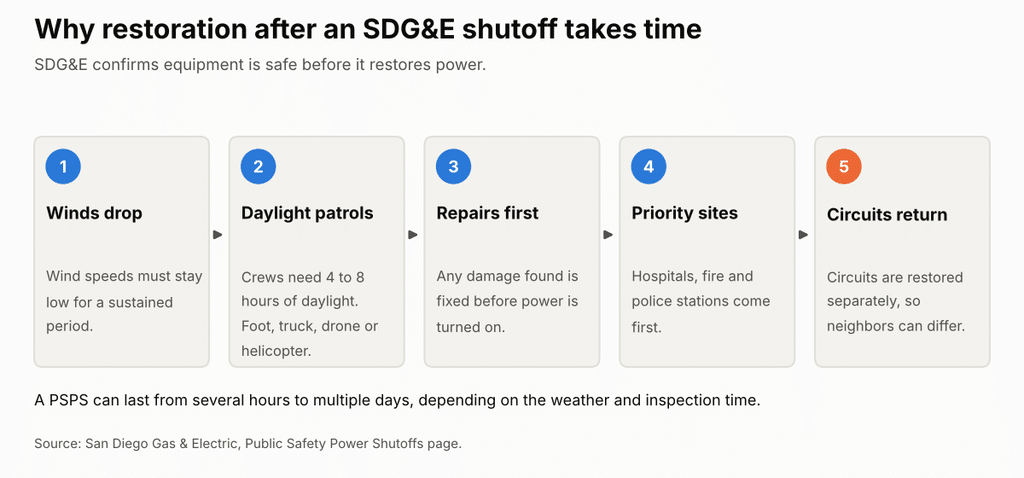
Restoration follows a set order:
- Wind speeds must drop and stay low for a sustained period.
- Crews need 4 to 8 hours of daylight to inspect lines and equipment, on foot, by truck, by drone or by helicopter.
- SDG&E makes urgent safety repairs and fixes any damage before turning power back on.
- Critical facilities, such as hospitals, fire stations and police stations, are prioritized.
- Circuits come back separately, so a neighbor may have power while you do not, and the reverse.
If you see a downed power line, call 911 or SDG&E at 800-411-7343. During a PSPS, SDG&E opens Community Resource Centers near affected communities, with free Wi-Fi, water, ice, snacks and device charging. Find them at sdge.com/wildfire-safety/community-resource-centers. You can also call 2-1-1 for free, confidential, 24-hour support in more than 200 languages.
Help for medical devices
SDG&E’s Medical Baseline Program is for households where someone has a qualifying medical condition or uses certain medical devices at home, such as a CPAP machine, a dialysis machine, an oxygen generator or a motorized wheelchair. Air filters, humidifiers and heating pads do not qualify.
The program gives you a discount for an additional amount of electricity at the lowest rates. SDG&E says enrolled customers may get extra support during a PSPS, including in-person contact attempts by SDG&E or partner agencies.
To enroll, complete a new application, have a physician certify it, and return it to SDG&E. A condition that is not permanent needs a new application and doctor’s certification every two years. A permanent condition needs a self-certification form every four years. For enrollment help, call 1-800-560-5551, Monday to Friday, 7 a.m. to 4 p.m. Start at sdge.com/medical. Other support, including accessible alerts, is at sdge.com/access-and-functional-needs-afn.
A utility alert is not a backup plan. SDG&E advises households that depend on medical equipment to arrange their own backup power supply.
Rebates for portable power
SDG&E’s Generator Assistance Program offers rebates of up to $300 on a new fuel generator and up to $150 on a portable power station. CARE and FERA customers get an additional $200 on a generator or $50 on a power station.
To qualify, you must live in a High Fire Threat District (Tier 2 or 3) and have experienced at least one PSPS. The product must be new and bought in California in 2026, and only one rebate of each type is allowed per household. Fuel generators must be CARB compliant with a carbon monoxide sensor and shutoff. Apply at sdgegap.clearesult.com with an itemized receipt.
These rebates cover portable equipment. They do not cover a home battery.
What solar plus a battery does
A portable power station or generator can run a few things. A battery paired with solar can back up your house.
If you have solar but no battery, your panels shut off when the grid goes down, even in full sun. The U.S. Department of Energy says grid-tied solar is designed to switch off if grid power cuts out. We explain why in Do Solar Panels Work During a Power Outage?
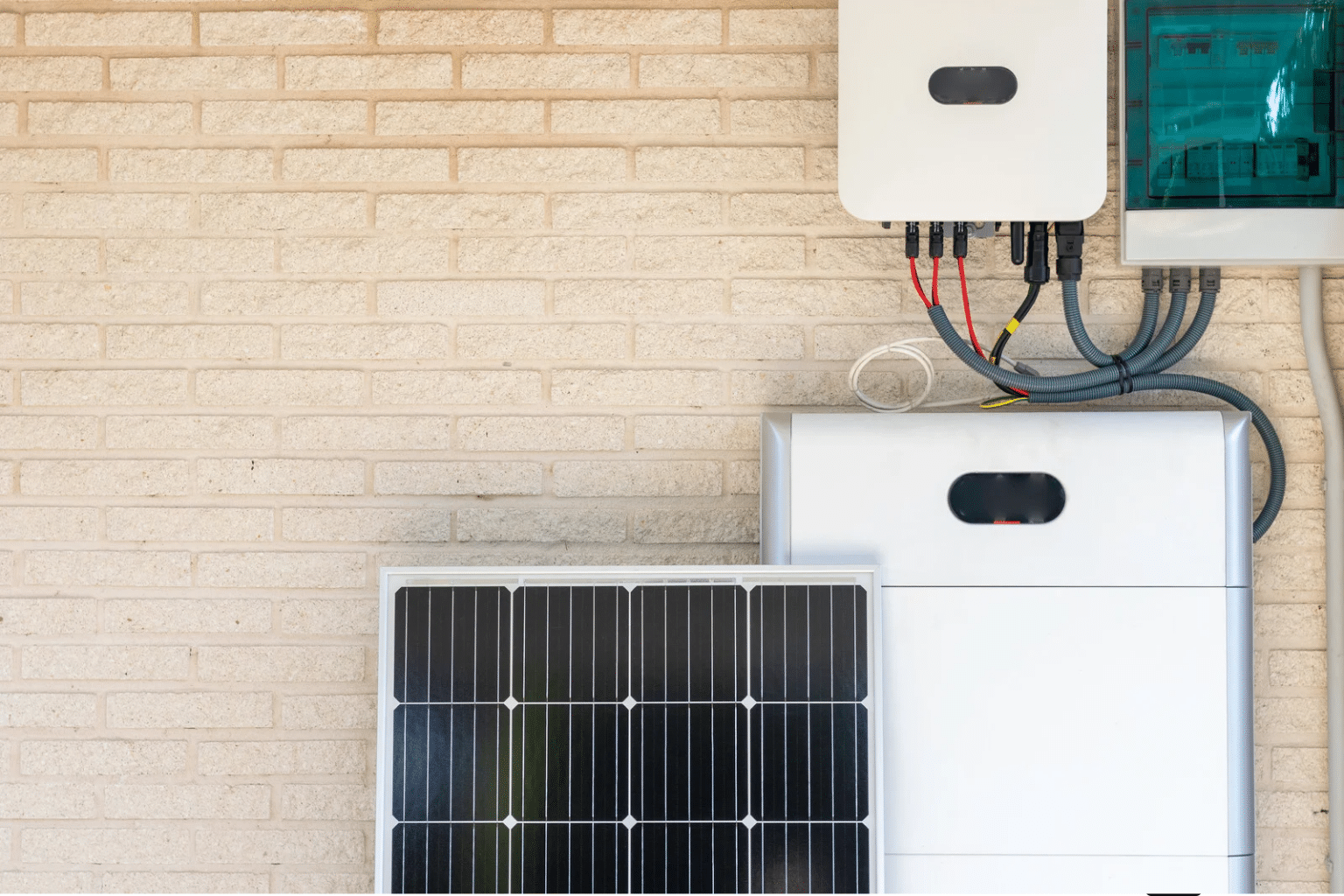
Add a battery and a backup gateway, and your home can disconnect from the grid and run on its own. Tesla says a Powerwall, together with a Backup Gateway or Backup Switch, powers the home during a grid outage. The Department of Energy says solar with storage can keep delivering power, even at night.
That matters in San Diego because SDG&E says a PSPS can last multiple days. A battery that is paired with solar can be topped up by the panels during the day, which a battery alone cannot do. EnergySage says one battery typically keeps essentials like a refrigerator, a Wi-Fi router and a few lights running for a day or two, and whole-home backup generally takes two or more.
HomeLink Solar’s Solar Plus program pairs solar with a Tesla Powerwall 3 for San Diego homes. [CONFIRM on the program page: what Solar Plus includes and who qualifies.] Our own crews do the installs, under CSLB license #1117534. See Solar Plus.
For help sizing a system, read our complete guide to solar battery backup in Southern California. Learn about our local work on the San Diego solar installation page.
FAQs
How much warning does SDG&E give before a shutoff?
SDG&E says it begins notifying customers about 48 hours before a possible PSPS, sends a follow-up about 24 hours before if a shutoff is still likely, and confirms the start time a few hours before.
How long can an SDG&E shutoff last?
SDG&E says a PSPS can last from several hours to multiple days. After the winds drop, crews need 4 to 8 hours of daylight to inspect equipment before power returns.
How do I check if my address is affected?
Use SDG&E’s outage map at outage.sdge.com, check the seven-day forecast at sdge.com/PSPS, or track up to five addresses in the Alerts by SDGE app. Update your contact details at sdge.com/notifications so you get warnings.
Why is SDG&E turning off power?
For a PSPS, SDG&E turns off power in specific areas during extreme fire weather, when strong winds and dry conditions raise the risk of equipment sparking a wildfire.
Is there help for medical equipment?
Yes. SDG&E’s Medical Baseline Program gives eligible customers a discount on additional electricity and may bring extra support during a PSPS. Start at sdge.com/medical, or call 1-800-560-5551.
Does Solar Plus work during an SDG&E shutoff?
Solar by itself does not, because panels shut off with the grid. Solar Plus pairs solar with a Tesla Powerwall 3, and a battery with a backup gateway can power the home during an outage.
Sources
- San Diego Gas & Electric: Public Safety Power Shutoffs
- San Diego Gas & Electric: Alerts by SDGE app
- San Diego Gas & Electric: Medical Baseline Program
- San Diego Gas & Electric: Generator Assistance Program
- Times of San Diego: SDG&E to begin public safety power shutoffs amid heat and Santa Ana winds (Oct 2, 2026)
- KPBS: SDG&E initiates power shutoffs amid extreme heat, Santa Ana winds (Oct 2, 2026)
- U.S. Department of Energy: Solar and Resilience Basics
- EnergySage: Do Solar Panels Work During a Power Outage?
- Tesla Support: Powerwall System Design